

Vehicle plants and battery investment
BMW is investing around €2 billion in vehicle production and battery manufacturing in Germany. Approximately €1 billion covers development of the Munich and Dingolfing vehicle plants; another €1 billion covers the Irlbach-Straßkirchen battery plant. Munich produces the electric i3, while Dingolfing accommodates combustion-engine and plug-in hybrid versions of the new 3 Series.
Around 760 supplier locations supply Munich and Dingolfing. More than 70% are in Europe and more than 30% in Germany, according to BMW’s September 2026 announcement. Irlbach-Straßkirchen is scheduled to supply batteries to Munich from October. The wider manufacturing network combines vehicle assembly with dedicated component, battery and production-development operations.

Rebuilding the Munich production process
Munich’s new body shop contains 800 industrial robots and reduces joining processes to five. BMW puts its automation rate at around 98%, with automated surface inspection supporting quality assurance. Steel and aluminium sheets first pass through automated press lines; camera-based inspection checks parts before an underground transport system takes them to the body shop. Sorted metal offcuts return to the manufacture of new coils. The paint shop uses automated surface inspection to detect deviations and automated surface processing to work on them during production.
Electrically powered exhaust-air treatment, energy recovery and water-saving cycles support painting operations. In assembly, interconnected vehicles, systems and tools provide live tracking and inline checks. The i3 transmits the status of up to 20,000 features to the production system. Munich moves around 2.5 million parts daily; future plans envisage 70% going directly to assembly workstations and automated systems handling around 60% of supply tasks. Ground-level deliveries and conveyors distribute material through the plant’s multi-storey logistics structure.
Electric-drive manufacturing in Steyr
BMW began series production of its Gen6 electric motor in Steyr, Austria, on August 1, 2025. The site continues making diesel and petrol engines alongside electric drives. BMW’s investment programme exceeds €1 billion between the project’s 2022 launch and 2030. Around 1,000 employees are intended for electric-motor assembly; the company says half of the site’s workforce could work in electromobility by 2030, depending on global demand. The modular manufacturing concept accommodates different drive derivatives and production volumes.
Steyr manufactures the rotor, stator, transmission and power converter. Landshut casts the aluminium motor housing, which is further processed in Steyr. Components feed two assembly lines, while converter production introduces an in-house clean-room environment. The converter uses 800-volt technology and silicon-carbide semiconductors to change battery direct current into alternating current for the motor. BMW’s comparison of a future Neue Klasse model with a Gen5 xDrive model attributes reductions of 40% in drive energy losses, 20% in costs and 10% in weight to the new system.

Virtual collision checks before physical installation
BMW’s Virtual Factory links building, equipment, logistics and vehicle data with simulations of manual work. Digital twins cover more than 30 production sites. The company uses NVIDIA Omniverse for real-time simulations of layouts, robots and logistics systems. In June 2025, BMW planned to integrate more than 40 new or updated vehicles into production by 2027, initially checking them virtually. A projected reduction of up to 30% concerns production-planning costs, rather than the cost of manufacturing every vehicle.
Automated collision checks combine construction data with three-dimensional scans. The system simulates vehicle movement and rotation through production lines to identify contact with surrounding equipment. BMW says a simulation taking three days replaced almost four weeks of physical testing. Previously, teams manually guided a real body through equipment, sometimes over several weekends. Paint-shop checks could require emptying and cleaning dip-coating tanks. Other applications include human simulations for manual tasks and generating surrounding-area maps from existing scans for smart transport systems. These applications address preparation of production equipment and material movement.
Automated vehicle movement inside factories
Automated Driving In-Plant moves newly built vehicles through defined factory routes. BMW began testing the system in Dingolfing in 2022 and announced the transition to series operation after CE certification in November 2024. At Dingolfing, 5 Series and 7 Series vehicles travel without a driver for more than one kilometre, from assembly halls through a short test course to the finishing area. Sensors installed along the route provide the environmental information used to control those movements.
The system combines external LiDAR infrastructure, an externally generated environment model, an external movement planner and cloud architecture. Its operation does not depend on the vehicle’s equipment options. Embotech supplied parts of the technology after earlier cooperation through BMW’s START-UP Garage. BMW also introduced the technology for the MINI Countryman and other models in Leipzig. Its November 2024 plans envisaged coverage of around 90% of Leipzig models, subsequent deployment in Regensburg and Oxford, and implementation at Debrecen’s production launch. Those rollout schedules were plans, while Dingolfing’s transition was the announced operating milestone.
Battery pilot plants and pack assembly
BMW develops high-voltage battery manufacturing at pilot plants in Parsdorf, Hallbergmoos and Munich’s Research and Innovation Centre, known as FIZ. In July 2025, more than 350 Parsdorf employees were building prototypes, with initial production dating to 2023. Some batteries had supplied Debrecen test vehicles since mid-2024. Hallbergmoos had developed assembly technologies since summer 2024, employing around 200 people and serving as a model for Woodruff. Another roughly 200 employees at FIZ manufactured and tested prototypes and smaller module variants.
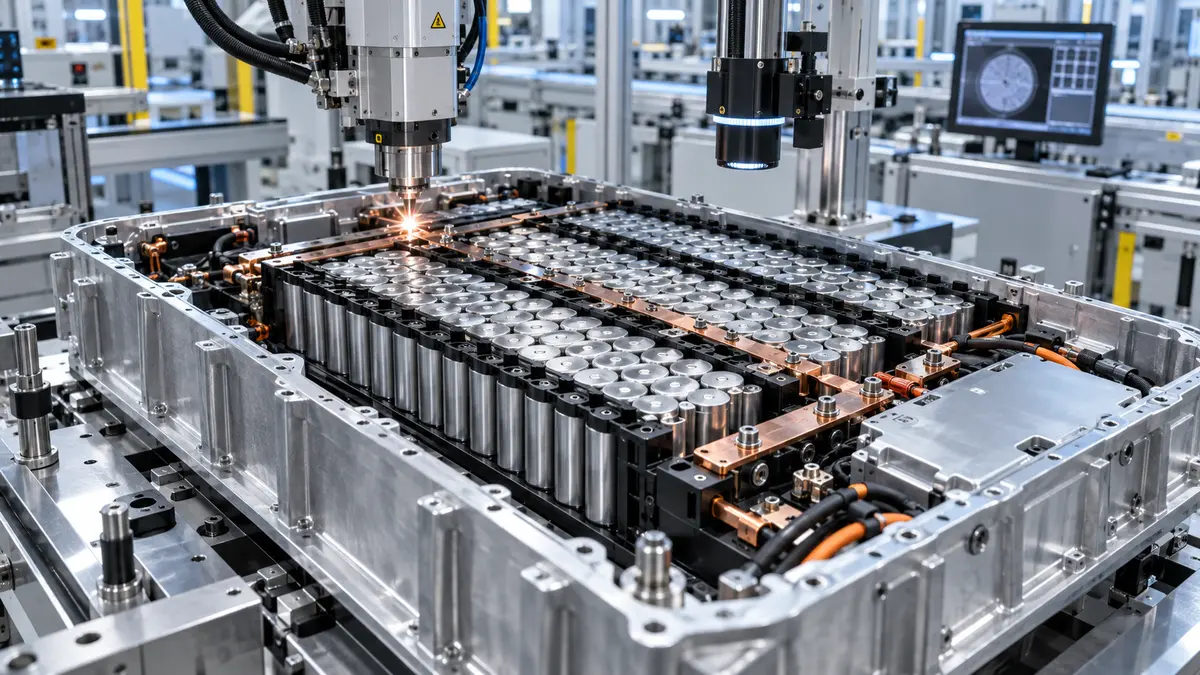
Battery-pack production begins with supplier cells made to BMW specifications. Receiving checks include voltage measurements. Cells are grouped with cooling elements; the clusters and contact system are laser-cleaned and welded, with every weld seam monitored inline. Foaming binds and protects the components as a mechanical unit. The housing is closed, sealed and riveted before the Energy Master control unit is installed. An elastic sealing adhesive provides the final seal. Every pack undergoes an end-of-line inspection for quality, safety and function. BMW’s zero-defect approach describes its production strategy and inspection system.
Production data from equipment to cloud
Data scientist and IT project manager Patrick Zimmermann coordinates the processing chain for BMW’s high-voltage battery production, from manufacturing data provision to applications at the equipment edge. His team connects sensor data, process information and machine interfaces. BMW uses OPC UA as a standardised interface through which equipment communicates with the production data platform. Numerical and visual information supports inline, AI-assisted quality checks. Equipment twins allow teams to investigate the roots of errors and simulate adjustments before changing a production installation.
The company transfers data into its cloud, organises it and provides standardised dashboards to teams across different locations. Zimmermann emphasises that an analysis or AI solution effective elsewhere may not work equally well in battery production. Development therefore involves close coordination with departments responsible for the actual processes. Greenfield battery plants offer room to coordinate digital structures from the outset. The architecture established in Bavaria’s pilot facilities can then transfer to series-production sites. The data system covers equipment connectivity, local applications and shared analysis, rather than simply collecting finished-battery inspection results.

Munich’s pre-series qualification
In February 2026, Munich began manufacturing its first near-series i3 test vehicles entirely on site. Earlier vehicles had been assembled at FIZ by teams from the pilot plant and Munich. The new manufacturing and logistics areas allowed test vehicles to pass through all production steps at the main plant. Quantities remained small, but parts already followed their designated material flows and were processed on the intended production line. The pre-series phase exercised the press shop, body shop, paint shop, assembly and logistics together.
Teams scrutinised every part and production step, with particular attention to approval inspections for new equipment and tools and their digital integration with existing systems. System tests provided information for further process adjustments. Employees moved from augmented-reality training to work on the actual installations and machinery. Peter Weber described the stage as preparation for a smooth series launch, with lessons from the ramp-up feeding into subsequent refinements. At that date, series production in the second half of 2026 remained the scheduled next phase.
Sample-cell manufacturing in Parsdorf
Parsdorf’s Cell Manufacturing Competence Center develops sample-cell production processes, a separate activity from assembling high-voltage battery packs. In October 2023, BMW described approximately 80 employees, a 15,000-square-metre centre and investment of around €170 million. Munich’s Battery Cell Competence Center develops cell designs; Parsdorf scales selected designs into production processes. The cylindrical sample shown at the opening measured 46 millimetres in diameter and 95 millimetres in height.
Electrode production starts by dosing and mixing ingredients including graphite and nickel oxides into a slurry. A thin layer coats metal foils before compression, or calendering. Cut electrode foils are wound with other components, inserted into a housing, filled with electrolyte, charged and tested. The centre also recovers and sorts production residues for return to the cell-production cycle. Its work spans product and process development, while BMW uses the resulting knowledge when setting production, quality, performance, cost and environmental requirements with suppliers.
Direct recycling of pilot-production materials
BMW and Encory commissioned the Cell Recycling Competence Center in Salching in December 2025. Direct recycling mechanically dismantles cell-production residues, including complete cells, and returns recovered materials to cell production without fully converting them back to their original chemical state. BMW developed the method internally. The company planned to reuse recovered material in Parsdorf’s pilot-cell production. This method differs from treating used vehicle batteries through black-mass production and hydrometallurgy.
Encory builds and operates the centre, while BMW retains intellectual property for the recycling method. BMW and Interzero each hold half of Encory. The Salching facility uses an existing hall with around 2,100 square metres of production and warehouse space, just under 350 square metres of offices and break rooms, and rooftop photovoltaics. The planned workforce is about 20. BMW envisaged staged expansion to annual recycling in the mid-double-digit tonne range once fully operational. That figure describes the intended scale of the process, rather than a verified annual recycling total at commissioning.
Energy Master production at Landshut
The Energy Master provides interfaces for high- and low-voltage power and battery data, controlling supply to the electric motor and vehicle electrical system. BMW developed its hardware and software internally, including electronic-fuse technology, and envisaged independent updates through Remote Software Upgrades. Landshut’s manufacturing system is also an in-house development. Its supply chain extends to lower-tier suppliers of critical components such as semiconductors. The control unit is installed on the high-voltage battery at the battery-assembly plants.
BMW’s February 2025 announcement placed Landshut in pre-series operation, with the first series line scheduled for August 2025 and another expansion stage for mid-2026. It envisaged approximately 200 employees initially, rising to as many as 700 during ramp-up. The final expansion stage could use up to 400 robots. Those workforce, equipment and timing figures were plans at publication. The modular system supports flexible production volumes. Quality measures include monitoring during production, AI-based camera systems and complete end-of-line system checks in a clean-room environment, connecting component assembly with functional verification.
The i3 series launch
BMW announced the i3’s Munich series-production launch on August 6, 2026. The vehicle was the second Neue Klasse model to enter series manufacture. The plant’s four-year conversion took place while existing vehicle production continued. A new body shop and assembly hall with integrated logistics occupied roughly one third of the site. BMW was also commissioning a delivery hall, where finished vehicles would receive final inspections before handover to sales.
The company said orders had opened ahead of schedule in mid-June and described demand as strong. Peter Weber attributed a further 10% reduction in manufacturing costs to the production launch, alongside the new architecture, planned processes and targeted automation. The figure is a company manufacturing-cost claim. Production employees continued developing the new processes during daily operation. Munich’s shift to exclusively electric vehicles from 2027 remained a future milestone, with further Neue Klasse models intended to follow the i3.
Used-battery recovery through SK tes
BMW’s European partnership with SK tes began on November 1, 2024. It covers batteries from development, production and European markets that are no longer fit for use. SK tes mechanically shreds the batteries, concentrating metals into black mass, before hydrometallurgical processing recovers nickel, lithium and cobalt. Recovered secondary materials return to battery manufacturing, including the Gen6 supply chain. BMW’s January 2025 announcement planned expansion to the United States, Mexico and Canada as early as 2026.
The partnership also feeds practical recycling experience into BMW development departments. Jörg Lederbauer, responsible for circular economy and spare-parts supply for high-voltage batteries and electric powertrains, described mutual learning within the closed loop. Nadine Philipp, responsible for sustainability in the supplier network, linked recyclable product development, greater use of secondary materials and closed material loops to supply-chain resilience. These are attributed company views. The routes in the battery material network include:

- Used batteries entering mechanical preparation and metal recovery.
- Recovered cobalt, nickel and lithium returning to new batteries.
- Practical recycling feedback reaching product-development teams.
Workforce qualification and flexible plants
BMW’s February 2025 manufacturing update described plants able to build different vehicle variants and drive types on one line. Milan Nedeljković said this flexibility supported delivery capabilities and capacity utilisation as electric-vehicle demand developed at different speeds. Munich and Debrecen were planned as the first exclusively electric sites. Concentrating Munich on one drivetrain also reduces manufacturing steps and parts, including wiring harnesses that previously differed with engine type. The production strategy therefore combines flexible plants elsewhere with dedicated electric operations.
Nearly 25,000 employees completed electromobility training in 2024. At the time of the update, Munich was conducting its third industrial-electrician qualification course with the Chamber of Industry and Commerce, IHK. BMW said around 5,500 jobs had been created across its production network for current and upcoming electric drives in recent years; more than three quarters were filled through internal reorganisation. Those employment figures refer to the wider network. Employees were prepared gradually for changed roles through further training and workforce flexibility, alongside the physical rebuilding of factories and component-production systems.



















Leave a comment