

A training centre inside the automotive plant
Boston Dynamics opened the Robotics Metaplant Application Center at Hyundai Motor Group Metaplant America outside Savannah, Georgia, on 21 September 2026. Atlas humanoids are learning manufacturing tasks at the automotive campus in the United States. Pilot operations began in June before the transition to full operations. Hyundai acquired complete ownership of Boston Dynamics in July. The training centre brings the robotics company into the automaker’s production environment, where the first assignments involve handling and sequencing components.
Other automakers are also expanding automation. Toyota plans to deploy nearly 400,000 robots from 2028: 150,000 across Toyota Motor and its group companies, and 250,000 at suppliers. Those figures include replacement robots and new units, including humanoids; they are not an order for 400,000 Atlas machines. Eric Booth, general manager of corporate communications at Toyota North America, confirmed the allocation without identifying suppliers or deployment locations in the United States. The manufacturing developments therefore involve separate programmes, with different deployment totals and purchasing arrangements.

From parts sequencing to wider industrial training
At RMAC, Atlas robots prepare automotive parts for assembly by placing them in the correct sequence. The work combines logistics with manipulation before components reach an assembly operation. Boston Dynamics plans to extend applications to component assembly by 2030 and later add other repetitive or physically strenuous assignments. The initial deployment ambition is 25,000 robots across Hyundai Motor and Kia plants over the coming years. Hyundai also plans a United States production facility capable of making 30,000 robots annually. The cumulative deployment target and annual manufacturing capacity describe different quantities.
RMAC’s first phase is operational, while its next building remains a project for 2027. Boston Dynamics expects the move within HMGMA to increase the centre to approximately ten times its current size. Further training could extend beyond automotive production. The company is discussing data collection and other tasks with existing Spot and Stretch customers in manufacturing, aerospace, semiconductors, logistics, food and beverage, and life sciences. Those discussions concern prospective Atlas training during 2027. Zack Jackowski, Boston Dynamics’ chief product and technology officer, presents the centre as part of a coordinated approach to supply chains, production, testing and deployment.

The product robot and its factory interfaces
The product version of Atlas debuted at CES in Las Vegas on 5 January 2026. A prototype also performed on stage; the demonstration robot and the newly unveiled commercial design were distinct versions. Boston Dynamics planned to begin manufacturing the product at its Boston headquarters immediately, with that year’s deployments committed to Hyundai’s RMAC and Google DeepMind. Additional customers were planned for early 2027. The product is fully electric and designed for industrial material handling and order fulfilment, rather than being limited to a single demonstration task.
Atlas has 56 degrees of freedom, fully rotational joints, a reach of 2.3 metres and a lifting capability of up to 50 kilograms. Boston Dynamics specifies operation between minus 20 and 40 degrees Celsius and describes the robot as highly water resistant. Operators can use autonomous operation, teleoperation or a tablet steering interface. Other announced capabilities include automatic battery replacement, human detection, fenceless guarding and integration with barcode scanners or RFID. Orbit software connects Atlas with manufacturing execution and warehouse management systems. Boston Dynamics also intends a task learned by one machine to be replicated across its fleet.

Reinforcement learning for dynamic factory skills
Boston Dynamics and the Robotics & AI Institute began a partnership in February 2025 to develop Atlas capabilities through reinforcement learning. Their shared training pipeline is intended to produce mobile manipulation behaviours that work across tasks and environments. The collaboration builds on earlier work involving Spot’s Reinforcement Learning Researcher Kit, which had explored new movements for the four-legged robot. The Atlas programme applies research to a different platform, combining humanoid mobility with manipulation. The teams identified three connected objectives:
- Transfer locomotion policies from simulation to physical hardware.
- Combine movement with handling objects, doors and levers.
- Develop whole-body contact strategies for demanding movements.
The research addresses tasks involving coordinated arms and legs, including manipulating heavy objects and dynamic running. Those are development objectives rather than a list of validated RMAC operations. Robert Playter, then Boston Dynamics chief executive, emphasised flexibility across different environments and applications. Marc Raibert, the institute’s executive director and Boston Dynamics founder, expected the collaboration to expand Atlas skills and simplify acquiring new behaviours. The Cambridge-based institute combines work on perception, situational understanding and reasoning with research into robots’ physical capabilities.

Actuators and the automotive component supply chain
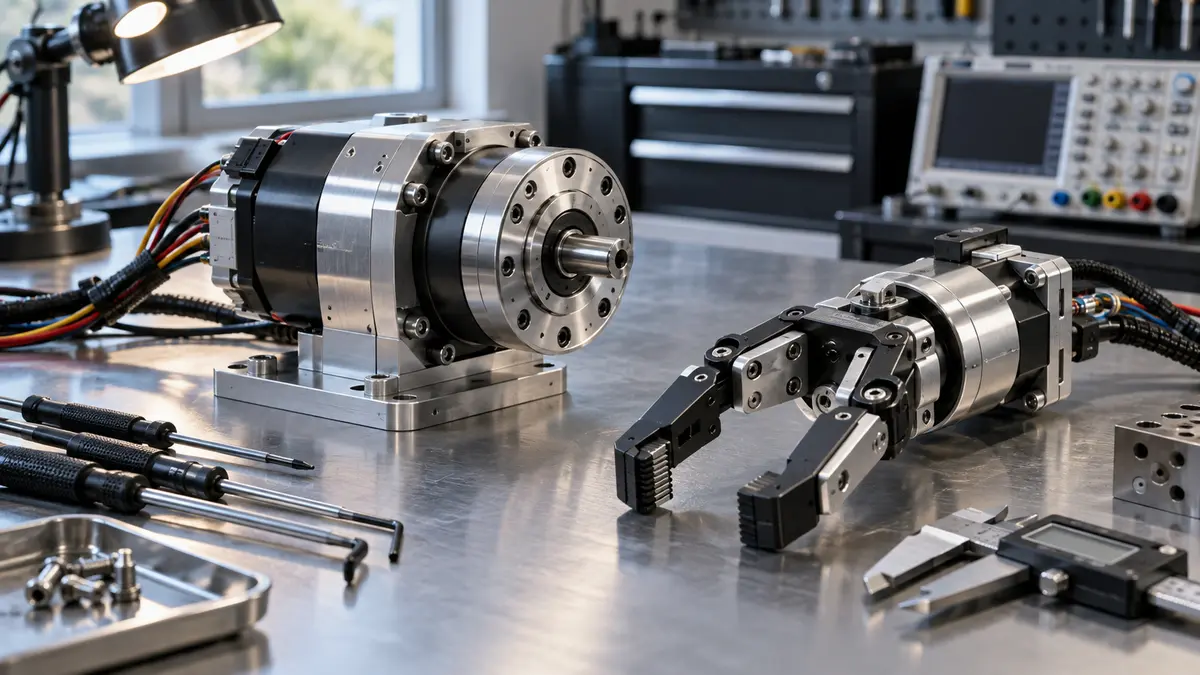
Hyundai Mobis agreed in January 2026 to supply actuators for Atlas, securing its first official customer in the robotics components sector. Actuators convert control signals into movement. Mobis estimates that they account for more than 60 per cent of a humanoid robot’s material cost; that is the supplier’s assessment rather than a published Atlas bill of materials. The company intends to apply its automotive engineering, reliability evaluation and volume manufacturing capabilities to robot components. Its plans include a large-scale actuator production system and stronger design capabilities for high-performance robotics hardware.
Se Uk Oh, vice president and head of Mobis’ Robotics Business Innovation Group, expects the collaboration to advance development, manufacturing and quality assurance. Jackowski, then general manager of Atlas, emphasised reliable component supplies and access to automotive cost structures and production scale. Mobis is headquartered in Seoul, South Korea, and its automotive portfolio includes electrification, steering, braking, chassis, lighting and electronics. Its research network includes centres in Korea, the United States, Germany, China and India. The actuator agreement extends that existing component business into humanoid robotics.
Manufacturing data and phased deployment
Hyundai’s January 2026 robotics strategy assigns different roles to group companies. Hyundai Motor and Kia provide production infrastructure, process control and manufacturing data. Hyundai Mobis develops components, while Hyundai Glovis supports logistics and supply chains. The software-defined factory approach began at Hyundai Motor Group Innovation Center Singapore before its development at HMGMA. Hyundai intends factory operating data and RMAC training datasets to support repeated improvements in robot behaviour. Training includes movements such as lifting, turning and recovering, alongside preparation for repetitive and complex assignments.
The deployment strategy calls for parts sequencing from 2028 and component assembly from 2030, following validation of safety and quality benefits. Hyundai aims for annual robot production capacity of 30,000 units by 2028. Its planned service model includes remote monitoring, software updates, maintenance, repair and overhaul. Robotics-as-a-Service subscriptions are intended to combine equipment with continuing support. Hyundai places robotics within broader investments of 125.2 trillion won in Korea over five years from 2026 and $26 billion in the United States over four years from 2025.

Whole-body learning with Toyota Research Institute
Boston Dynamics and Toyota Research Institute established a research partnership on 16 October 2024 to develop general-purpose humanoid capabilities. The project combines Atlas hardware with TRI’s Large Behavior Models. Boston Dynamics had developed interfaces for commanding and teleoperating whole-body movements and two-handed manipulation. TRI brought work on diffusion policies, open robot models and datasets, computer vision, and model training. Its objective is to develop foundation models that can perform multiple manipulation tasks using visual information and language instructions, instead of programming every movement separately.
Scott Kuindersma, then senior director of robotics research at Boston Dynamics, and Russ Tedrake, then vice president of robotics research at TRI, were appointed to lead the Boston-based collaboration. The programme uses robot performance data to train models and compares results through hardware and simulation evaluation. Research questions include how humanoids acquire skills, how models use whole-body sensing and how human interaction and safety can be assessed. Gill Pratt, Toyota’s chief scientist and TRI chief executive, viewed applying the institute’s AI to Atlas as a significant opportunity. TRI was established in 2016, with offices in Los Altos and Cambridge.

Whole-body demonstrations and adaptation
Boston Dynamics and Toyota Research Institute demonstrated a Large Behavior Model controlling Atlas on 20 August 2025. The robot walked, crouched and lifted objects during a continuous sequence of packing, sorting and organising tasks. Researchers introduced disturbances while it worked, including closing a box lid and sliding the container across the floor. Atlas adjusted its actions in response. A single model controlled the whole robot, including its hands and feet. The demonstration combined manipulation with locomotion instead of presenting walking and arm movements as separate capabilities.
Scott Kuindersma, Boston Dynamics’ vice president of robotics research, expected training a single neural network on varied tasks to improve generalisation. Russ Tedrake, TRI’s senior vice president of Large Behavior Models, described adding skills through human demonstrations and reducing the number of examples needed as models improve. Those were the researchers’ assessments of their approach. The joint project studies models for whole-body control, advanced manipulation and dynamic behaviour. Its August demonstration established a research milestone before the January 2026 product unveiling and RMAC’s subsequent opening. It did not establish that every planned factory assignment had already been commissioned.

Google DeepMind joins the Atlas programme
Boston Dynamics and Google DeepMind announced an AI partnership on 5 January 2026. The teams intend to combine Atlas with Gemini Robotics foundation models, beginning with industrial tasks in automotive manufacturing. Joint research was planned at both organisations in the months following the announcement. The project addresses the robot’s ability to interpret its surroundings and instructions as well as its ability to move. Google DeepMind’s models draw on the multimodal Gemini family, which works with several forms of information rather than language alone.
Alberto Rodriguez, director of robot behaviour for Atlas, described a need for visual-language-action models that could work reliably across complex tasks and different industries. Carolina Parada, DeepMind’s senior director of robotics, outlined research into new models and safe, efficient scaling. The organisations presented the programme at Hyundai’s CES media event. Boston Dynamics had announced its intention to commercialise a humanoid in 2024, following advances in AI that changed how robots could be trained. The January partnership established a research direction for Atlas; it did not announce completed validation of every manufacturing task or an immediate general-purpose rollout across all factories.

Perception, instructions and physical actions
Gemini Robotics and Gemini Robotics-ER were introduced on 12 March 2025, before the Atlas partnership. The former adds physical actions as an output to a Gemini 2.0-based vision-language-action model. The latter concentrates on embodied reasoning and spatial understanding, allowing roboticists to connect its output with their own control programmes. DeepMind’s goals include generalisation to unfamiliar situations, interaction with changing instructions and dexterous manipulation. Demonstrated tasks included origami folding and placing a snack in a bag, which require coordinated movements rather than simply recognising objects.
The initial training primarily used the two-arm ALOHA 2 platform. DeepMind also demonstrated control of a Franka-based setup and adaptation to Apptronik’s Apollo humanoid. These examples involved other robots, rather than validated Atlas factory deployments. Gemini Robotics could respond to changes such as a moved item or an object slipping from a grasp. The reasoning model addressed perception, state estimation, planning and code generation. DeepMind paired this work with low-level protections for collision avoidance, contact forces and dynamic stability, plus the ASIMOV dataset for examining the safety of possible robotic actions.
Learning on the robot itself
Gemini Robotics On-Device followed on 24 June 2025, with a model designed to operate locally instead of depending on a data network. DeepMind positioned it for latency-sensitive applications and locations with intermittent or absent connectivity. Its developer toolkit supports evaluation, simulation in MuJoCo and adaptation to new tasks. The company demonstrated fine-tuning with as few as 50 to 100 examples. That range describes its research experiments and does not establish how many demonstrations every RMAC manufacturing assignment requires.
The model was trained on ALOHA robots and then adapted to the two-arm Franka FR3 and Apollo humanoid. Demonstrations included folding clothes, handling unfamiliar objects and precision belt assembly. DeepMind initially offered access through a trusted tester programme to collect feedback on capability and safety. The architecture connects high-level model output with safety-critical controllers on the robot. It also supports evaluation through semantic safety tests and exercises intended to expose failure modes. Local execution is one approach within DeepMind’s robotics portfolio; the Atlas collaboration did not identify this specific model as the deployed control system for every machine at RMAC.
Separating task planning from movement control
On 25 September 2025, DeepMind introduced Gemini Robotics 1.5 and Gemini Robotics-ER 1.5. The reasoning model plans activities, assesses progress and can call digital tools. It passes instructions to the vision-language-action model, which turns visual information and language into movements. Both models were trained for their respective roles. The architecture lets a longer assignment be broken into steps while retaining information about its overall objective. DeepMind demonstrated this approach with tasks such as sorting objects according to local recycling rules and separating laundry by colour.
Gemini Robotics 1.5 also demonstrated transferring learned movements among ALOHA 2, Apollo and Franka platforms. DeepMind evaluated the reasoning model across 15 academic benchmarks, including pointing and embodied question answering. Its safety approach combines reasoning about actions with robot-level protections, such as collision avoidance, and an expanded ASIMOV benchmark. The reasoning model became available through the Gemini API, while the action model remained accessible to selected partners. These developments provide technical background to the later Atlas research partnership. RMAC’s immediate assignment remains training robots for manufacturing, with broader deployment and assembly applications tied to Hyundai’s phased timetable.



















Leave a comment