
From winter trials to manufacturing
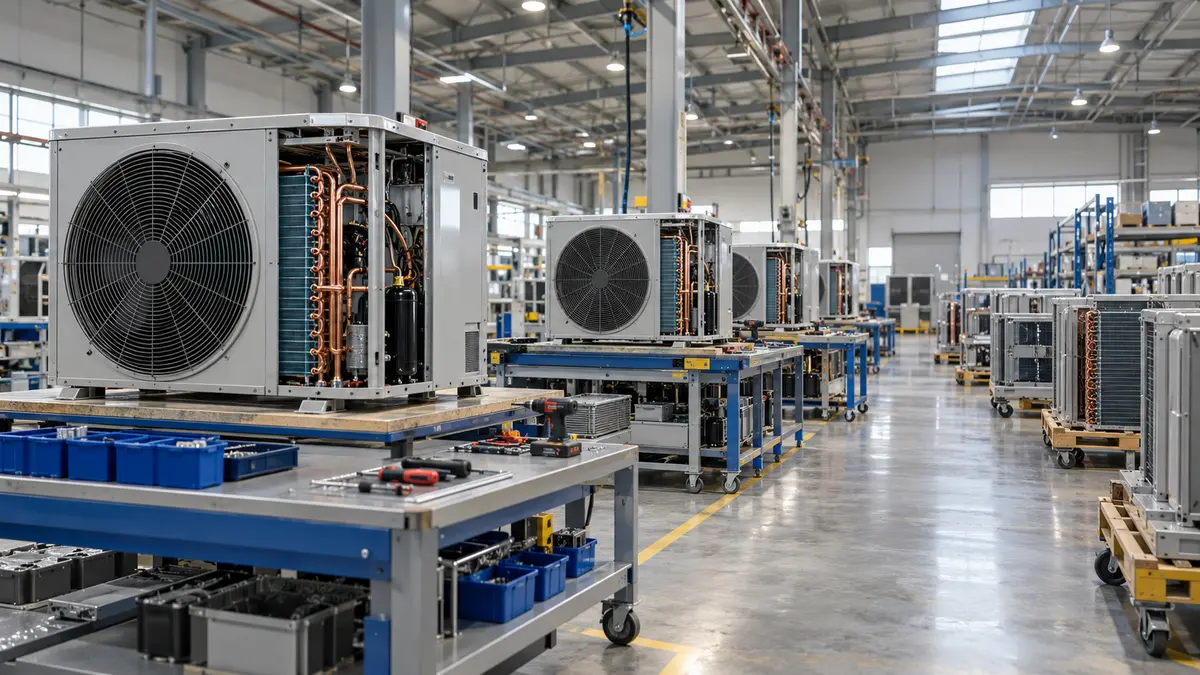
Eight manufacturers completed field testing in the Department of Energy’s Residential Cold Climate Heat Pump Challenge as announced on October 23, 2024: Bosch, Carrier, Daikin, Johnson Controls, Lennox, Midea, Rheem and Trane Technologies. Trials covered 23 sites across ten states in the United States and two provinces in Canada. Some units could operate at −15°F while meeting efficiency requirements, DOE said. Manufacturers expected commercial production as early as that autumn. Carrier’s Braden Cook, senior director of product management, training and service, identified controls, heat exchangers and variable-speed compressors as technologies being adapted for commercial buildings. Lennox’s Ajay Iyengar, vice president of advanced technology, described variable-speed drives, wet injection and internally developed control algorithms, including demand-response capability. Larger capacities, ventilation requirements, component layouts and different control protocols required additional work for commercial rooftops, he explained. The November 4, 2024 editorial coverage connected the residential testing milestone with that continuing commercial development programme.
Johnson Controls separates laboratory and home testing
Johnson Controls completed its laboratory testing phase before announcing the result on January 9, 2024. The company said its prototype exceeded the challenge’s low-temperature performance benchmarks and delivered seasonal heating efficiency above that of its baseline products. During laboratory work, the prototype operated at the coldest temperature that the test cell could register; the announcement did not attach a numerical temperature to that description. Three field sites were scheduled to operate through the winter heating season to validate performance in occupied conditions. David Budzinski, then president of Residential and Light Commercial, described the work as addressing technological barriers to residential heating electrification in cold climates. The company also connected its research with a separate initiative to expand three domestic factories in partnership with DOE’s Office of Manufacturing and Energy Supply Chains. Their combined prospective capacity was approximately 200,000 electric heat pumps annually. That figure described the planned manufacturing capability of the facilities, rather than measured production from the three prototype installations.

What the laboratory tests measured
Oak Ridge National Laboratory tested a nominal three-ton Rheem system under a cooperative research agreement documented by Stephen Kowalski and Jeffrey Munk in September 2024. The equipment included an outdoor unit, indoor air handler, supplementary electric resistance heat kit and proprietary thermostat. Environmental chambers provided the indoor and outdoor conditions. The laboratory used indoor air enthalpy as its primary capacity measurement and refrigerant enthalpy as a secondary method. Rheem’s sample satisfied the laboratory requirements, including an adjusted heating seasonal performance factor, HSPF2, of 9.4 against an adjusted minimum of 8.5. Its commercialisation assessment was explicitly based on one sample. The September technical report separated three types of operation:
- Regulatory tests used a special operating mode without supplementary electric heating.
- Cold-climate tests used the thermostat and enabled the specified supplementary heater.
- Demand-response tests applied signals supplied by the National Renewable Energy Laboratory while Oak Ridge personnel observed the system.
Measurements in existing homes
Jon Winkler and Sugi Ramaraj investigated centrally ducted, variable-capacity air-source systems in a separate 2023 National Renewable Energy Laboratory field-validation project. Its homes already had high-efficiency central heat pumps installed. Most sites were in the Northwest, where electric space heating and incentives for efficient heat pumps had supported recruitment. A home in a Denver suburb provided the study’s only dual-fuel installation. Ecotope, a Seattle consultancy, assisted with recruiting sites, installing monitoring equipment and managing data quality. Airside measurements and electricity measurements were collected at five-second intervals to quantify heating capacity, coefficient of performance and auxiliary-heater consumption. Algorithms distinguished operating modes, including defrost and supplementary heating. Initial visits included whole-house thermal assessments and duct audits to estimate winter heating requirements. Researchers calculated design loads at ASHRAE 99% design temperatures and compared them with manufacturers’ maximum capacities. Those methods addressed installed equipment, building loads and auxiliary energy alongside the heat pump’s own operating characteristics.

Airflow and elevation in a separate experiment
In May 2024, Winkler and Greg Shoukas documented laboratory work for Xcel Energy on two Bosch systems: a centrally ducted unit and a multi-split unit operating with two indoor heads. Tests examined low-temperature capacity, airflow and the effects of elevation at Golden, Colorado. Average heating capacity was 5.5% lower for the central system and 7.4% lower for the multi-split system under the laboratory’s lower barometric pressure than under the simulated sea-level airflow conditions. The central unit’s coefficient of performance at 5°F was about 11% higher at the highest tested indoor airflow than at the lowest. These were measurements of two specific systems, rather than a universal adjustment for all heat pumps. The facility was not a certified rating laboratory, and its methods differed from standard product-rating procedures. The study did not calculate annual performance, duct distribution losses, cost effectiveness, carbon reductions or supplementary heating consumption. Its findings therefore retain the tested equipment, airflow and environmental conditions.
Different products reach the market on different dates
Carrier announced completion of its residential challenge work on September 12, 2024, with production scheduled that month at Collierville, Tennessee. Three Infinity variable-speed trial units with Greenspeed Intelligence had operated in Syracuse, New York homes during the 2022–2023 heating and cooling seasons. Carrier distinguished reliable field operation down to −13°F from laboratory operation down to −23°F. It specified full rated heating capacity at 5°F for the new units. Bluetooth modules were intended to support digital monitoring and dealer servicing through its Connected Portal. The units used R-454B, sold under the Puron Advance name. An advanced defrost feature monitored the outdoor coil for frost, adjusted compressor speed during defrosting, and ended the cycle after detecting that the frost had melted and drained. Nick Arch, vice president and general manager of Residential HVAC Solutions, attributed the development to the engineering team’s additional innovations. The September announcement established a production schedule; it did not quantify finished factory shipments.

Bosch makes IDS Ultra available to professionals
Bosch Home Comfort announced the market launch of its IDS Ultra on October 28, 2024, after displaying the system at the AHR Expo and Consumer Electronics Show that January. HVAC professionals could purchase the units ahead of the winter season. Bosch specified operation in climates reaching −13°F and 100% heating capacity down to 5°F, compared with the 70% capacity it cited for IDS Premium. The company also gave a coefficient of performance of 2.1 for the enhanced performance described in its release. An enhanced vapour injection compressor supported heat absorption from cold outdoor air. Demand-response functionality allowed utilities to manage electrical load with the homeowner’s permission. Bosch described the unit as compatible with existing air-to-air systems and compliant with the new low global warming potential A2L refrigerant requirements. Senior product manager Mohamad Nasab characterised the design and testing as supporting performance during harsh winters. These are Bosch’s product specifications and claims; they retain their stated temperatures and conditions.
Midea pairs the outdoor unit with a modular air handler
Midea launched its EVOX G3 heat pump system on May 10, 2024, combining an outdoor heat pump with a modular air handling unit. Its 1.5-ton to five-ton outdoor range used enhanced vapour injection and a multilayer heat exchanger. Midea described a two-stage compression process with an intermediate injection of refrigerant vapour to increase heating output in cold weather. The indoor unit’s Block N Lock construction separated into three pieces for transport and installation in restricted spaces such as attics, basements and crawlspaces. One air-handler configuration could serve six installation positions. Automatic adaptation to 120-volt or 230-volt supplies and compatibility with existing 24-volt systems addressed replacement installations. The system supported dual-fuel operation with an existing gas furnace and an optional electric heat kit. Midea also specified demand-response and CTA 2045 functionality. The same announcement discussed a forthcoming challenge prototype separately; those prototype results were not specifications establishing the performance of every launched EVOX G3 configuration.

Lennox introduces another model in February 2025
A later launch followed on February 20, 2025, when Lennox introduced the Dave Lennox Signature Collection SL22KLV cold-climate heat pump. The company described the model as an enhancement of its challenge development, with operation in temperatures as low as −20°F. Published efficiency ratings reached 21.10 SEER2, 13.2 EER2 and 10.50 HSPF2. Its variable-speed compressor used electronic refrigerant injection, adjusting operation according to outdoor conditions. A precision-balanced direct-drive fan and sound-dampening system addressed noise. The model paired with the Lennox S40 Smart Thermostat, while built-in sensors supported temperature adjustment, maintenance and dealer troubleshooting. R-454B was the specified refrigerant. Chief technology officer Prakash Bedapudi attributed the design to the company’s effort to maintain performance and efficiency in demanding climates. Orders were available through local dealers at the time of the announcement. This February 2025 product milestone came after the eight-manufacturer field-testing announcement; its specifications belong to that later model and launch date.
Trane’s later launch retains its own testing record
On October 1, 2026, Trane Technologies introduced the Trane 20 TruComfort Cold Climate Heat Pump with WeatherGuard and American Standard AccuComfort Platinum 20 Cold Climate Heat Pump with All Weather. The company specified 100% heating capacity at 5°F and continued operation down to −20°F. Nearly 18,000 hours of additional field testing covered homes in Minnesota, Montana, New York, Pennsylvania, Wisconsin and Texas, with observed outdoor temperatures as low as −21°F. Both systems supported dual-fuel installations with furnaces. Variable-speed compressors could adjust in increments as small as 0.1%, and airflow algorithms supported supply air temperatures up to 110°F. Link communicating technology connected equipment, smart thermostats and indoor air-quality systems; dealers could use remote diagnostics and improved system visibility. Zoning required compatible Link-enabled indoor equipment. Residential HVAC president Mark Majocha described the launch as expanding practical access to residential electrification. The October 2026 announcement placed availability in that autumn, a distinct milestone from completion of the earlier challenge.

Commercial rooftops have a separate development programme
DOE launched the Better Buildings Commercial Building Heat Pump Accelerator on April 3, 2024. Manufacturers were to develop more efficient rooftop equipment, while commercial organisations evaluated and adopted the technology. Amazon, IKEA and Target helped develop the accelerator. Its initial manufacturing participants included AAON, Carrier Global, Lennox International, Rheem Manufacturing, Trane Technologies and York International. The department aimed to bring next-generation rooftop units to market as early as 2027. It estimated that broad deployment could save businesses and commercial entities $5 billion in annual utility costs. Those savings were a programme-level potential, rather than recorded savings from the residential trial homes. Energy secretary Jennifer Granholm presented the accelerator as a way to move technologies from laboratories into the market. It sat within the wider Better Buildings Initiative, whose public and private partners shared energy-efficiency approaches. Commercial organisations and manufacturing partners therefore had separate development and adoption roles, alongside the residential manufacturers’ own product testing and launch schedules.
Factory selections remain conditional
A separate DOE announcement on August 7, 2024 selected nearly $85 million for negotiations with four manufacturers across five factories in New York, Tennessee, Texas and Rhode Island. The proposed projects covered electric heat pumps, heat-pump water heaters and components. Their prospective additional annual output included 155,000 residential heat pumps, 440,000 residential heat-pump water heaters, 2,000 school heat pumps and 20,000 large compressors. DOE expected more than 500 jobs, including 220 in disadvantaged communities. Its Office of Manufacturing and Energy Supply Chains administered the selections under Defense Production Act authority. Selection did not commit the department to issue an award or provide funding. Negotiations and environmental review were required before funding, and DOE could cancel negotiations or rescind a selection. The production and employment figures consequently described the proposed projects’ potential. They were not completed output totals, and their mixed product categories extended beyond the eight residential challenge participants’ cold-climate units.

Shipments and market conditions use different measures
AHRI’s December 13, 2024 statistical release recorded 365,388 air-source heat-pump shipments to customers in the domestic market during October, up 61.8% from 225,834 a year earlier. January-to-October shipments reached 3,581,109, compared with 3,213,895 during the same period of 2023, an increase of 11.4%. The combined central air-conditioner and heat-pump total was 815,360 for October, up 53.1%, and 8,455,008 for the year to date, up 8.9%. AHRI defined a shipment by transfer of ownership; consignment did not qualify. Participating member companies supplied the aggregated data, and the published cumulative figures incorporated revisions. The association did not identify a cold-climate challenge subset or provide public state-level figures. Shipment counts also did not identify completed installations in homes. AHRI explicitly distinguished shipments from sales and did not provide market forecasts. The December release supplied a later statistical view of October activity, with a broader equipment scope than the residential field-testing programme.
The 2023 global comparison
The International Energy Agency’s Renewables 2024 market assessment placed those developments against a weaker global heat-pump market in 2023. Newly installed capacity fell 3% worldwide after strong growth in 2022. Air-to-air heat-pump sales declined 15% in the domestic American market, while air-to-water sales fell 10% in Japan. European heat-pump purchases contracted 6.5%, although they remained at their second-highest level. China’s market grew 12%, partly offsetting declines elsewhere. The IEA associated the changed market with high borrowing costs, inflation, reduced construction, lower natural-gas prices and policy changes. It also identified some American consumers delaying purchases in anticipation of state-administered rebates. These measures cover different equipment categories, regions and periods from AHRI’s October 2024 shipment figures. The IEA’s policy assessment called for consistent support for households facing financing constraints and for attention to the electricity-to-gas price gap. That attributed market context accompanies the technical and factory milestones without converting announced products or prospective capacity into realised installations.




















Leave a comment