
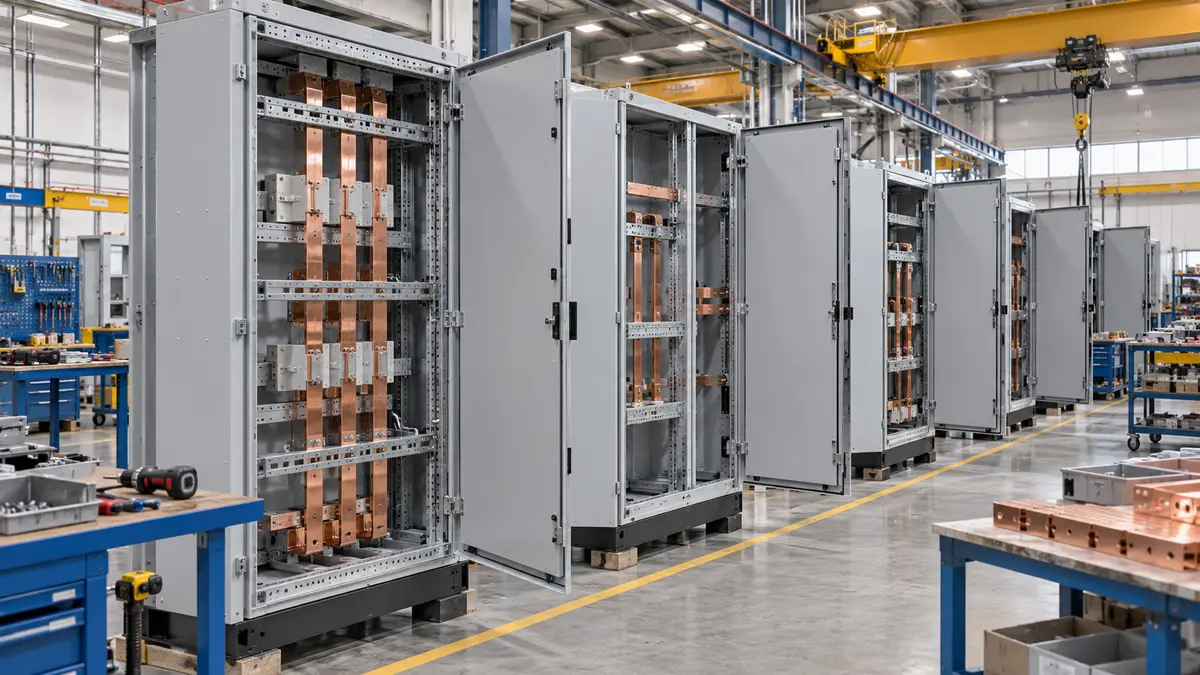
A global data-center business
Eaton plans to establish a global business segment focused on data centers, with Angie McMillin becoming its president on 01.04.2026. McMillin outlined the plans in an interview on 26.03.2026. She described an effort to bring the company’s existing data-center teams into a more cohesive global unit.
Eaton has supplied power equipment to the sector for decades. Its Electrical Americas sales increased 16.1% to approximately $13.3 billion in 2025; Electrical Global sales rose 9.1% to $6.8 billion. McMillin linked its move into liquid cooling to increasing power consumption and heat at the chip level. She also anticipated further announcements about expanding power-equipment production in the United States. McMillin’s manufacturing interview

Electrical orders and reporting periods
Eaton’s 2025 sales reached $27.4 billion, increasing 10% from 2024, with 8% organic growth and 2% growth from acquisitions. Fourth-quarter sales were $7.1 billion, up 13% from the corresponding quarter. That quarterly increase comprised 9% organic growth, 2% from acquisitions and 2% from foreign exchange. These totals cover Eaton’s businesses rather than data-center equipment alone.
Electrical Americas recorded fourth-quarter sales of $3.5 billion, up 21%, comprising 15% organic growth, 5% from acquisitions and 1% from currency movements. Its quarterly operating profit reached $1.0 billion, up 14%, with an operating margin of 29.8%. Its rolling twelve-month organic orders increased 16%, while December-end backlog rose 31% from December 2024. Electrical Global’s quarterly sales reached $1.7 billion, up 10%, with 6% organic growth and 4% positive currency translation. Its rolling orders grew 6% and year-end backlog 19%. Across the electrical businesses, the rolling twelve-month book-to-bill ratio was 1.1. Eaton published these results on 03.02.2026, ahead of the new segment’s planned formation.

The original Boyd Thermal agreement
Eaton signed an agreement on 03.11.2025 to acquire Boyd Thermal from Goldman Sachs Asset Management for $9.5 billion. The agreed price represented 22.5 times the business’s estimated adjusted EBITDA for 2026. That earnings measure was non-GAAP; Eaton said it could not reconcile the estimate to the corresponding GAAP measure without unreasonable effort because forecasting the necessary amounts was difficult.
Boyd Thermal forecast 2026 sales of $1.7 billion, including $1.5 billion in liquid cooling. The transaction required customary closing conditions and regulatory approvals, and Eaton initially expected completion in the second quarter of 2026. Chief executive Paulo Ruiz described the intended combination of liquid-cooling technology, global service capabilities and Eaton’s existing power-management portfolio. Doug Britt, then identified as Boyd Thermal’s chief executive, likewise presented the combined offering as a way to serve customers’ high-power AI requirements. The revenue and earnings figures were forecasts attached to the acquisition agreement.
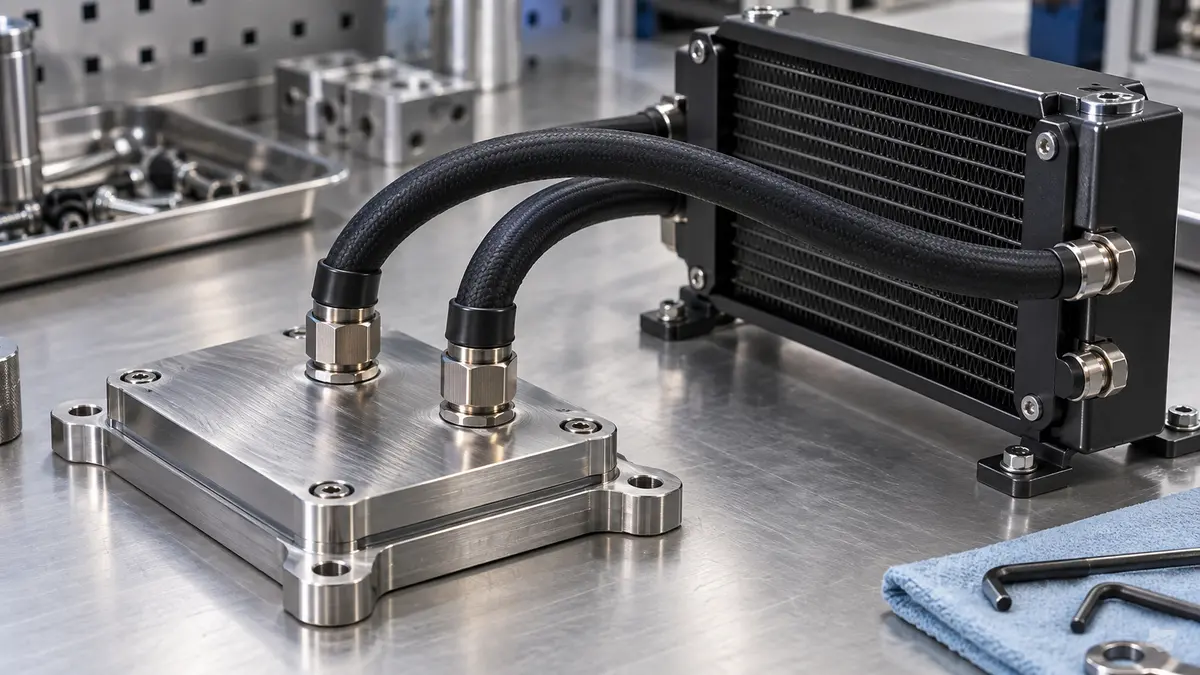
Cooling manufacturing joins the portfolio
Eaton completed the acquisition of Boyd Thermal on 12.03.2026. The acquired business had more than 6,000 employees and manufacturing sites across North America, Asia and Europe. Its portfolio included thermal components, systems and ruggedized solutions for data centers, aerospace, industrial customers and other markets.
Boyd Thermal’s history began with industrial fabrication in 1928 and included decades supplying aerospace thermal-management equipment. At completion, Eaton said the business would be reported within Electrical Global and was expected to add to adjusted earnings in the second year after closing. Ruiz described liquid cooling as part of Eaton’s intended integrated power-and-cooling offering. The completed purchase brought an established engineering and manufacturing organization into Eaton; the anticipated financial contribution remained a future expectation.

Power distribution production in Virginia
Eaton announced investment exceeding $50 million in a new Henrico County, Virginia, manufacturing campus on 10.12.2025. The planned 350,000-square-foot facility would more than double its Richmond-area footprint and add capacity for static transfer switches, power distribution units and remote power panels. Production was expected to begin in 2027.
The campus would consolidate manufacturing from three nearby facilities, each within three miles of the new location. Existing employees would move to the new site, while the investment was expected to create 200 additional jobs, with hiring beginning in 2026. State and local economic-development incentives supported the project. Aidan Graham, senior vice president and general manager of Critical Power Solutions, associated the expansion with customers’ increasing AI power requirements. Eaton placed the campus within its North American manufacturing program, which had attracted more than $1.2 billion of electrical-solutions investment since 2023.

An earlier electrical manufacturing program
Eaton had announced an additional $150 million for North American electrical power-distribution manufacturing on 13.09.2023. The program included an $80 million commitment in El Paso, Texas, covering a new facility and increased capacity at an existing plant. More than 600 skilled manufacturing jobs were planned there.
The expansion covered circuit breakers, switchboards, panelboards and other electrical assemblies serving critical infrastructure. Eaton also planned capacity increases in Beaver, Pennsylvania; Juarez, Mexico; Arecibo, Puerto Rico; and Haina, Dominican Republic. Mike Yelton, president of the Americas Region in Eaton’s Electrical Sector, identified buildings, healthcare facilities, data centers, industrial sites and utilities as customers. Eaton characterized the $150 million as additional to a previously announced $500 million program for electrification, energy transition and digitalization.

Three-phase transformer capacity
Eaton announced a $340 million investment on 12.02.2025 to increase US production of three-phase transformers. It planned to convert an existing building in Jonesville, South Carolina, into its third US manufacturing site for that transformer category. Production and hiring were expected to begin in 2027, with 700 local jobs planned. The location would become Eaton’s eleventh facility in South Carolina.
The company intended to continue three-phase transformer manufacturing at two Wisconsin facilities, including operations in Waukesha. Its Nacogdoches, Texas, site would continue making single-phase pole-mounted and pad-mounted transformers. Eaton worked with readySC and regional schools on recruitment and industry training for Jonesville. Local, state and federal incentives supported the project. Yelton described increasing electrical demand across utilities, industrial customers, data centers and buildings as the setting for the investment. The Jonesville plan added manufacturing capacity to Eaton’s transformer footprint while preserving the existing Wisconsin and Texas operations and their different product categories.

Investment in factory-built power modules
NordicEPOD secured a strategic commercial investment from Eaton and CTS Nordics on 03.06.2024. The Oslo-based manufacturer specialized in fabricating and integrating standardized power modules for data centers. CTS Nordics supplied data-center design and construction capabilities, while Eaton brought power-management technologies.
The partners planned an immediate output increase at NordicEPOD’s existing factory and a larger Oslo factory opening in August, with annual capacity exceeding 500 megawatts of EPODs. They were also discussing another European factory whose location had not been selected. General manager Morten Molven associated the investment with secure supply and meeting customer requirements. Eaton’s Ciarán Forde noted that NordicEPOD already participated in its xModular partner program. The announced megawatt capacity described the expansion plan, rather than a count of modules already produced or delivered.

Commissioning before modules leave the factory
Eaton and CTS Nordics announced the new NordicEPOD factory’s opening on 26.09.2024. The 12,000-square-metre facility in Hanekleiva, near Oslo in Norway, had capacity to manufacture up to 350 modules annually and an expanding workforce of 300. Each EPOD could support up to two megawatts of electrical power between the grid and a data center’s IT infrastructure.
The modules combined critical power, backup, cooling and control systems. Their Eaton equipment included EnergyAware UPS units using silicon-carbide inverters, sulfur-hexafluoride-free medium-voltage switchgear, transformers and ring main units. Modules left the factory digitally enabled with Level 1–3 commissioning complete. NordicEPOD supplied digital passports and traceability, while allowing customer-specific adaptations to the standard design. These provisions formed part of factory assembly and preparation before integration at the construction site. NordicEPOD’s factory opening

Pre-integrated electrical enclosures
Eaton completed its $1.4 billion acquisition of Fibrebond on 01.04.2025. Based in Minden, Louisiana, Fibrebond designed and built pre-integrated modular power enclosures for data centers, fiber infrastructure, industrial customers and utilities. Its campus included a 300,000-square-foot electrical integration facility, a customer-equipment warehouse and the main manufacturing plant.
Fibrebond estimated revenue of approximately $378 million for the twelve months ending 28.02.2025. Eaton expected $110 million of adjusted EBITDA from the business in 2025 and forecast a neutral effect on that year’s earnings per share. Yelton identified engineered-to-order enclosures and service capabilities as additions to Eaton’s existing offering. The transaction supplied an established off-site enclosure manufacturing business alongside the company’s electrical equipment operations.
Modular construction and on-site generation
Eaton and Siemens Energy announced a joint approach to data-center construction and on-site power generation on 03.06.2025. Their concept allowed both elements to be built simultaneously, with grid connections and renewable-energy integration where required. Siemens Energy’s standard power-plant configuration provided 500 megawatts using SGT-800 gas turbines, redundancy and battery storage, with its modular layout allowing the plant size to change.
The concept included an optional clean-air grid connection, installed during construction or later as a retrofit. Future carbon-neutral operation depended on hydrogen being available and included in the customer’s sustainability strategy. Eaton would provide medium- and low-voltage switchgear, UPS units, busways, structural supports, racks and containment systems, plus engineering services and software. These products supported skidded and modular designs from the medium-voltage grid to IT loads. Eaton’s global data-center segment leader Cyrille Brisson described flexibility in customers’ choice of energy sources and noted the need for land close to gas, water and fiber infrastructure.
Equipment in the 800 VDC reference design
Eaton introduced a reference architecture supporting NVIDIA’s 800 VDC power approach on 13.10.2025. The design combined power distribution with energy storage for the increasing demands of AI infrastructure and megawatt-scale racks. Eaton identified several components in its reference offering:
- supercapacitors for fast-cycle backup power;
- busbar power distribution within the ORV3 design;
- hot-aisle containment supporting busway and cable trays;
- DC connectors.
JP Buzzell, Eaton’s vice president and data-center chief architect, described the architecture as part of its grid-to-chip strategy and collaboration with NVIDIA. Dion Harris, NVIDIA’s senior director for HPC, Cloud and AI Infrastructure, associated streamlined 800 VDC designs with high-density computing and energy efficiency. Eaton planned to show the developments at the Open Compute Project Global Summit in San Jose, California, on 13–16.10.2025. The offering was a reference design for future infrastructure, rather than a tally of operating installations.
Meter firmware for changing AI loads
Eaton announced a firmware-based addition to its Power Xpert quality event analysis system on 09.09.2025. The PXQ power-quality meter operates in switchgear, switchboards and power distribution units, using edge analytics to identify events including voltage sags, swells, transients and harmonics. The update added detection of potential subsynchronous oscillations in data centers.
Eaton connected the development to AI power bursts: large fluctuations in energy demand associated with intensive GPU workloads. It warned that such oscillations could damage transformers and other infrastructure. Customers could obtain the new detection capability through a remote firmware upgrade to an existing PXQ meter. Detection would give operators information for preventive action; Eaton described the capability as helping them address problems before lasting equipment damage. Buzzell placed the update within the company’s power-management program for data centers and the grid. Eaton scheduled presentations by Buzzell and Peter De Bock, vice president of energy and cooling, at Yotta in Las Vegas on 08–10.09.2025. The announcement concerned event identification and operator response rather than an independently measured reduction in outages.
Power equipment and modular compute halls
Eaton announced its Flexnode collaboration on 28.01.2026, with plans to supply backup-power equipment, racks and cable-management technologies for modular compute infrastructure. Eaton also led Flexnode’s Series A funding round. The companies proposed turnkey, prefabricated IT infrastructure for high-density data halls ranging from 3.5 to 35 megawatts, with multiple halls deployable on one site.
Eaton technologies would be integrated into the Flexnode NX Compute Module. The collaboration combined Eaton’s 800 VDC infrastructure approach with Flexnode’s modular construction process from design through deployment. Linsey Miller, senior vice president and general manager of Distributed IT at Eaton, described AI, high-performance computing and quantum workloads as driving rack densities beyond one megawatt. She presented modular systems as adaptable to changing load profiles and repeatable across locations. Flexnode chief executive Andrew Lindsey described the partnership’s intended combination of architecture, engineering and construction. The proposed halls and equipment integration extended Eaton’s modular portfolio from electrical enclosures into infrastructure for computing workloads.
A shared power-and-cooling blueprint
Eaton unveiled Beam Rubin DSX on 16.03.2026, integrating its grid-to-chip architecture with NVIDIA’s Vera Rubin DSX AI Factory reference design and Omniverse DSX blueprint. The pre-engineered offering covered grid infrastructure, power distribution and advanced cooling at the chip level, scaling from megawatts to hundreds of megawatts. Eaton drew on Fibrebond, NordicEPOD and its Flexnode collaboration for the modular construction approach.
The company supplied SimReady three-dimensional assets in OpenUSD for the Omniverse blueprint. These digital twins would allow power and cooling systems to be simulated alongside compute models, with customers designing and validating energy infrastructure before construction. McMillin associated the platform with energy flexibility and modular scalability. NVIDIA vice president of AI infrastructure Vladimir Troy described the need to co-design power, cooling and computing for large AI installations. Eaton presented the physical equipment portfolio and digital models as parts of a repeatable implementation, bringing its electrical manufacturing, factory-built modules and acquired thermal capabilities into one infrastructure offering. Beam Rubin DSX architecture



















Leave a comment