
Chirano’s underground fleet order
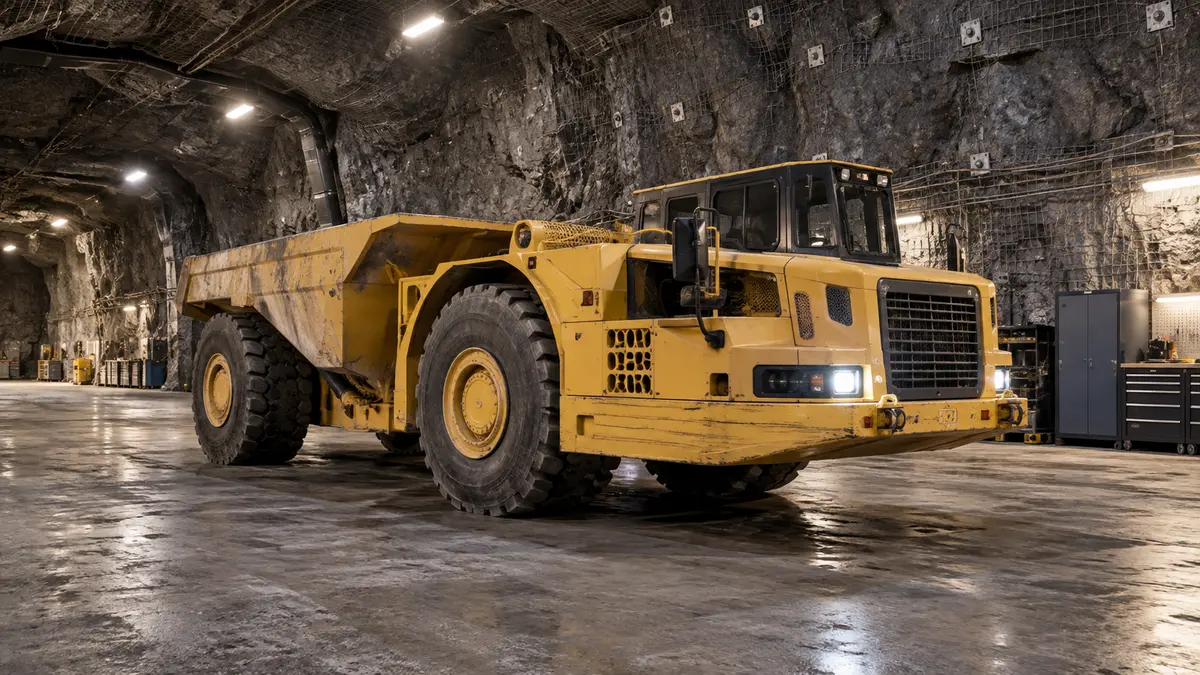
Asante Gold ordered Epiroc underground equipment for its Chirano gold mine in southwestern Ghana. The order, announced on Oct 8, 2025, was worth approximately SEK 115 million, or $12 million, and entered Epiroc’s third-quarter order intake. Deliveries had begun and were scheduled to continue over the following months. The combined open-pit and underground operation selected four machine types:
- Minetruck MT65 S haulers;
- Scooptram ST18 S loaders;
- Boomer M20 S face drilling rigs;
- Simba E70 S production drilling rigs.
The Smart-series machines are automation-ready. Epiroc will supply tools, spare parts, service and digital situational awareness covering tonnage, cycle times and metres drilled. Epiroc CEO Helena Hedblom anticipated better monitoring and safety; Asante CEO Dave Anthony expected the fleet upgrade to support higher gold production.
The mine plan behind fleet renewal
Chirano’s equipment renewal formed part of a longer development programme. Asante’s May 1, 2024 planning update envisaged rebuilding and replacing underground machinery, with larger equipment intended to raise productivity and reduce mining costs. Five underground mines supported the production plan, with Suraw and Obra receiving particular attention for the 2026–2028 period. Open-pit mining was expected to continue through 2026 to maintain a balance of feed from the operation’s surface and underground workings.
The underlying technical report was dated Apr 30, 2024, with an effective date of Dec 31, 2023. Asante projected Chirano gold production of 178,000 ounces for the period from February 2025 through January 2026, and more than 200,000 ounces for its 2027 planning year. The company also evaluated connecting northern mines to the processing plant by conveyor. That opportunity remained outside the technical report’s production plan. Extending mine life beyond the reserve-based 2028 endpoint depended on resource conversion, deeper underground infrastructure and additional pits.

Production, costs and processing work
Chirano produced 128,840 gold-equivalent ounces in the year ended Jan 31, 2025, against 138,434 a year earlier. Lower feed grades affected both the final quarter and the full year. Annual all-in sustaining costs rose from $1,879 to $1,939 per ounce, reflecting lower sales volumes, maintenance expenses and sustaining investment. Asante treats this cost measure as a non-IFRS indicator. For the subsequent year ending Jan 31, 2026, its May 2025 outlook targeted 155,000–175,000 gold ounces.
The planned processing programme covered carbon-in-leach agitators and intertank screens, cyclone upgrades for grinding control, carbon regeneration, and gold-room electrowinning cells and rectifiers. Asante sought an annual mine production rate of four million tonnes. Underground priorities included developing Obra northward and at depth, sustaining Suraw ore delivery, and continuing Akwaaba, Tano and Akoti operations. Exploration drifts from Obra were intended to test and reclassify Sariehu and Mamnao resources. Conveyor feasibility work and the start of Aboduabo oxide mining were additional planned initiatives.

Exploration alongside underground development
Asante completed 126 exploration holes totalling 13,561 metres at Chirano during the part of 2025 covered by its Oct 6 update. This represented 43% of the year’s drilling programme. The work comprised 2,438 metres of reverse-circulation drilling, 9,610 metres of diamond drilling and 1,513 metres of auger drilling. Obra, Suraw and Sariehu were among the areas where the company identified mineralisation with potential to support resource growth and longer mine life.
Magnetic Hinge, approximately three kilometres south of Akwaaba, advanced to the pre-feasibility stage for a potential shallow oxide development. Mapping and geophysical work on the Anansu prospecting licence identified eight drill-ready targets along a corridor of about two kilometres. Asante planned approximately 15,000 further metres of Chirano drilling for the remainder of 2025. Its priorities included extending mineralised structures downward and laterally, upgrading resources and testing additional targets. These were exploration and planning activities, with updated technical reports then scheduled for April 2026.
Face drilling with the Boomer M20 S
The Boomer M20 S also operates at Stawell Gold Mines in Victoria, Australia. In a 2025 customer feature, Epiroc described a 14-metre rig with two booms, internal hydraulics and the RCS 5 control system. Its operator uses two touchscreens, one for each boom. The internal arrangement removes exposed hydraulic hose bundles from the front of the machine. Stawell personnel associated this design with improved visibility and reduced exposure to hose damage and maintenance work.
Epiroc’s Fleet+ telematics and Stawell’s own systems recorded a weekly result of 8,390 development drill-hole metres and an average 15% improvement in drilling metres per hour against the mine’s existing jumbos. These were Stawell results. Its team was also introducing ABC Total, which uses a digital drill plan to automate a sequence of holes. Maintenance superintendent Jake McInerney described 600 holes completed through supervised automation over six weeks. Operators retained a supervisory role while the rig moved its booms and located drilling positions.

Production drilling and the COPROD option
Epiroc introduced COPROD for its Simba underground production drilling family on Sep 23, 2024. The system combines characteristics of tophammer drilling with the hole straightness and quality associated with down-the-hole drilling. It is available for the Simba E60 S and E70 S. Epiroc claimed penetration rates up to three times those of traditional drilling methods, alongside improved precision. The offering combines the drilling system, Smart-series rigs, digital tools and the company’s 6th Sense optimisation approach.
Chilean copper producer Pucobre had used COPROD for Simba since 2022 and ordered three additional Simba E70 S rigs equipped with it. Epiroc attributed better fragmentation, dilution reduced to 5%, and a burden increased to 2.4 metres to the Pucobre application. Pucobre CEO Sebastián Rios linked its choice to variable rock quality and smaller, irregular ore bodies in the Atacama region. Those operating results concerned Pucobre’s mines; the Chirano order identified the E70 S model without specifying the COPROD drilling configuration.
Service and long-running automated rigs
At LKAB’s Malmberget mine in northern Sweden, four Simba E6 C WL production rigs had each passed one million drilled metres by December 2024. They belonged to a six-rig fleet purchased in 2012. The million-metre milestones were cumulative machine totals. Epiroc associated their longevity with maintenance support and established automation functions. LKAB drilling production manager Björn Öderyd highlighted the contribution of skilled service technicians to keeping the sophisticated equipment operating over successive years.
The Malmberget rigs used Automatic Boom Control, known as ABC Total, together with teleremote control. An operator could oversee multiple machines, with remote operation also supporting drilling during night shifts and shift changes. LKAB ordered another six Simba rigs, with the first delivery planned by the end of 2024. The machines included customer-specific LKAB Wassara hammers and automation functionality. This installation provides a separate example of the Simba family’s service and control arrangements, involving a different model and mine from Chirano.

The functions within Deep Automation
Epiroc launched Deep Automation for underground material handling on May 30, 2023. The suite coordinates loaders and trucks through interfaces connecting mine-planning tools, machines and auxiliary equipment. Its Deep Control application manages safety, production assignments and autonomous traffic in real time. Deep Routes records and adjusts routes for machines, while Deep Safety manages production-area access and flexible safety zones. These functions serve different parts of fleet coordination and control.
Deep Fleet Simulations allows a production area to be modelled before mine development or an automation installation. Deep Insights provides operational data for monitoring and improving an automated fleet. Epiroc developed the suite with interoperability across platforms as a design objective. The company’s Smart- and Green-series trucks and loaders use its Rig Control System and are prepared for automation and remote control. The launch offering concerned material handling; the specific combination of applications used at an individual mine depends on that installation.
Mixed equipment at Cadia
Newmont’s Cadia operation in New South Wales used Deep Automation to orchestrate a production level from the surface. A September 2025 customer feature described six to eight Scooptram ST18 loaders working simultaneously between draw points and a crusher. Operators could bring in a rock breaker, a MacLean Engineering water cannon or an inspection robot through teleremote control while other machines continued working. The arrangement combined Epiroc loaders with equipment supplied by other manufacturers.
The project addressed the inrush risks associated with Panel Cave 1. Newmont and Epiroc began working toward a remotely operated production level in 2017, including the ability to clear blocked draw points without sending personnel into the production area. Surface operators worked from a control room with individual stations and shared operational dashboards. About 20 Epiroc employees were stationed at Cadia, mainly for fleet service and maintenance. Newmont’s operations and technology leaders credited the partnership and equipment interoperability with enabling the production arrangement.

Automation capability through ASI Mining
Epiroc completed its purchase of the remaining 66% of ASI Mining on Jul 3, 2024. It had held 34% since 2018. The transaction followed an agreement announced on May 29, 2024, and brought the autonomous mining solutions business into full ownership. ASI Mining, based in Mendon, Utah, supplied remote-control, teleoperation and fully autonomous systems. Its technology was designed to work across equipment brands, including mixed mining fleets.
ASI Mining generated approximately SEK 300 million in revenue in 2023. The parties did not disclose the purchase price. Epiroc identified safety, productivity, emissions and operating costs as intended benefits of the acquired systems. It also expected a positive revaluation of the ownership interest it already held, to be reported as an item affecting comparability in Equipment & Service during the third quarter of 2024. That accounting effect related to the previously owned stake, alongside the acquisition of the remaining shares.
Wireless infrastructure for connected fleets
Epiroc took full ownership of Radlink on Apr 2, 2025, after acquiring a 53% holding in 2022. The Perth-based business designs, delivers and integrates wireless voice and data networks for surface and underground mines. Its infrastructure supports communication between equipment and operating systems, including teleremote and autonomous applications. Radlink employed approximately 415 people and generated about SEK 1.33 billion in revenue in 2024.
Earlier in 2025, two Australian mining companies had ordered Radlink-provided long-term evolution, or LTE, and digital connectivity solutions worth more than SEK 250 million. Epiroc announced those orders on Jan 16. The supply included telecommunications towers, equipment huts and power systems for remotely located mines. The stated applications included automation, fleet management and real-time data, supported by secure, high-speed wireless bandwidth. These connectivity projects concerned the Australian customers; Chirano’s October order specified situational awareness without identifying a Radlink network installation.
A separate collision-avoidance deployment
Hindustan Zinc and Epiroc signed an agreement to deploy Epiroc’s Collision Avoidance System across five underground mines in Rajasthan, India. Announced on Aug 29, 2025, the programme was to proceed in phases, starting at Sindesar Khurd. The pilot covered 30 low-profile dump trucks and 100 pedestrians. The system is designed to work with vehicles from different manufacturers, allowing mixed fleets to use the same collision-avoidance technology.
Epiroc CEO Helena Hedblom described intelligent sensing, real-time alerts and autonomous vehicle control as elements of the safety system. Hindustan Zinc CEO Arun Misra connected the deployment with the company’s broader programme of digital safety improvements. The initial agreement specified a pilot and phased expansion to the remaining mines. It covered an active collision-avoidance application alongside Epiroc’s wider connectivity, mine-planning and automation portfolio. Chirano’s announced digital supply covered tracking and production metrics; the Indian programme had its own equipment, personnel and rollout scope.
Battery-electric variants at Lalor
Hudbay Minerals ordered battery-electric Epiroc equipment for its Lalor underground mine at Snow Lake in Manitoba, Canada. Announced on Mar 13, 2025, the approximately SEK 100 million order entered first-quarter bookings. It included Boomer M20 SG face drills, Scooptram ST18 SG and ST14 SG loaders, and Minetruck MT42 SG haulers. Deliveries were scheduled between the first and third quarters of 2025, with aftermarket service and rock drilling tools included in the supply.
Hudbay had already tested a battery-powered Scooptram loader at Lalor over the preceding years. Its management cited operator satisfaction, maintenance and emissions benefits when expanding the fleet. At the announcement date, Epiroc had received battery-electric vehicle orders for 39 mine sites worldwide. Approximately one-third of mines with those vehicles in production had placed repeat orders. Epiroc’s electrification services also covered infrastructure, chargers, maintenance and recycling. Lalor’s SG battery-electric models were a separate configuration from the S-series equipment named in Chirano’s order.

The drilling portfolio expands in 2026
Epiroc extended Deep Automation to underground drilling and bolting on May 28, 2026. The expanded concept brought these activities together with the material-handling applications introduced in 2023. Its stated scope ranged from remote operation to higher levels of autonomy. Epiroc intended the common portfolio to coordinate technologies across drilling, reinforcement and the movement of mined material, while retaining interoperability with equipment and systems from different suppliers.
Global automation lead Guilherme Paiva claimed that drilling automation could enable development rates up to 30% faster and stoping cycles up to 70% shorter. Epiroc also cited customer examples involving more than 15% higher mine output through continuous crusher feeding during blast clearance, and over 3,000 additional tonnes per truck per month through autonomous haulage across shift changes. The company presented these as technology and customer-performance examples. It did not identify them as measured outcomes from the Chirano fleet or its October 2025 digital order.

Chirano’s subsequent fleet and development progress
By Mar 16, 2026, Asante reported that more than 95% of Chirano’s underground fleet had been mobilised following refurbishments and Epiroc deliveries. Several new units had arrived more than three months late. Underground development had remained above 1,100 metres per month since November 2025. Asante had opened multiple Obra draw points, deployed an experienced development crew and worked with manufacturer maintenance support to address earlier shortfalls in development and equipment availability.
Bridging in several slot raises had affected November and December production and was subsequently resolved. With the expanded fleet deployed, underground development began at Tano and Akoti Far South. Asante expected these areas to provide more higher-grade ore by mid-2026. Its March operational update put Chirano’s February 2026 gold production at approximately 11,000 ounces, explicitly describing that figure as preliminary and unreconciled. The update combined completed equipment and development work with remaining production objectives for the mine.



















Leave a comment