
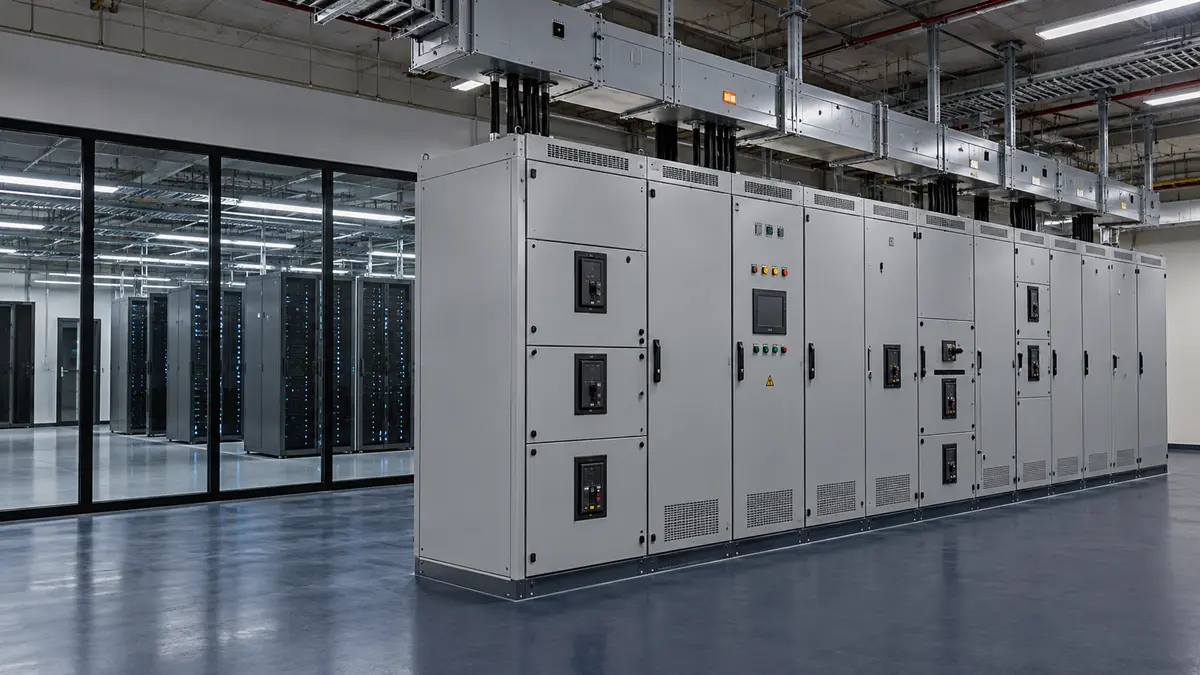
Data centres within a building-infrastructure group
Legrand, based in France, generated €8.65 billion in sales during 2024, above its company-compiled consensus of €8.54 billion. Data centres contributed €1.6 billion. Adjusted operating profit reached €1.78 billion, against expectations of €1.73 billion. Chief executive Benoît Coquart attributed the performance to data-centre products and acquisitions amid depressed building markets.
North and Central America accounted for 40.1% of revenue and grew 4.5% organically; the United States represented 37% and grew 5.7%. Europe supplied 40%, with organic sales down 2.3%. These growth rates exclude changes in consolidation scope and exchange rates. Legrand initially targeted combined organic and acquisition growth of 6–10% for 2025, excluding currency effects. Coquart expected wider adoption of open-source AI, including DeepSeek, to increase demand for data processing, while keeping guidance unchanged. The following chronology follows the equipment portfolio through subsequent developments.

Remote access and infrastructure management
Legrand announced ZPE Systems on 08.11.2023, subject to standard conditions precedent. The Fremont, California, business employed more than 140 people and generated annual sales above $80 million. Its secure serial console servers and service routers provide remote access to network IT equipment, covering both data centres and edge installations.
ZPE’s products address infrastructure management, resilience and security. Legrand expected increasingly complex AI, edge-computing and operational-technology installations to require intelligent equipment management across dispersed locations. That expectation formed part of its rationale for entering this product segment. Its existing data-centre range already included power distribution units, busways, cabinets, racks, fibre and copper cabling, and keyboard-video-mouse systems. ZPE was the fourth acquisition announced that year, following Clamper in Brazil, Encelium in the United States and Teknica in Chile.
The 2023 financial starting point
Data centres accounted for 15% of Legrand’s group revenue in 2023. Across the whole company, reported sales grew 0.9%; growth excluding exchange rates and Russia was 4.7%. The adjusted operating margin reached 21.0%, while earnings per share increased 15.6%. Free cash flow of approximately €1.6 billion represented 18.8% of revenue and a 53% increase.
Legrand had announced five acquisitions over the preceding year, including two in data centres. For 2024, management initially expected slightly positive, low-single-digit sales growth combining organic development and acquisitions, excluding exchange rates and Russia. Its initial adjusted operating-margin objective was 20.0–20.8% before acquisitions. Coquart linked the 2023 performance to innovation, pricing and productivity measures during a retreat in building markets. These figures cover the wider electrical and digital building-infrastructure business, alongside the expanding data-centre activities.

Racks in India and a separate healthcare transaction
Netrack joined Legrand’s acquisition programme on 23.04.2024. The Bangalore business manufactures server and network racks, with more than 250 employees and annual revenue of approximately €10 million. Its manufacturing operations added an Indian rack specialist to the data-centre portfolio. Netrack’s product range serves both server installations and network equipment.
The same announcement included Enovation, a separate connected-health and assisted-living software company based in Rotterdam. That transaction remained subject to standard conditions precedent. Enovation employed more than 350 people and generated annual sales above €60 million, largely recurring. Its business-to-business software supports remote monitoring, health-information sharing and care coordination. It belonged to the Legrand Care offering rather than the rack business. Both purchases sat within the company’s broader acquisition programme; Enovation’s healthcare revenue was therefore distinct from Netrack’s data-centre equipment activity.

Distribution equipment and busbars
Davenham and VASS followed on 11.06.2024. Davenham, based in Dublin, supplied low-voltage power distribution systems for data centres, including protection, switching, metering and energy distribution. It also provided commissioning and aftermarket services. The Irish company employed 350 people and generated annual revenue of approximately €120 million, with business in Europe and the United States.
VASS, based in Ingleburn near Sydney, manufactured busbars, principally for data centres. It employed nearly 40 people and generated annual revenue just below €10 million in Australia and the wider Asia-Pacific region. Coquart presented the two transactions as additions to both server-room infrastructure, or white space, and technical-room infrastructure, or grey space. With these deals, Legrand had made ten data-centre acquisitions over five years. Its five acquisitions announced during 2024 by that point represented combined annualised revenue above €200 million.

Commissioning and maintenance in Colombia
UPSystemas, announced on 03.09.2024, added technical-infrastructure integration and services in Colombia. The Bogotá company employed more than 300 people and generated annual revenue of approximately €30 million. Its work covered integration, commissioning, maintenance and monitoring, particularly for data centres. Legrand counted it as its fourth data-centre acquisition announced in 2024.
The same announcement included Australian Plastic Profiles, known as APP, based in Sydney. APP produced cable conduits for a wider range of building types, employed approximately 250 people and generated annual revenue above €100 million. Its acquisition remained subject to conditions precedent. Together with earlier transactions, the two announcements brought Legrand’s 2024 acquisition count to seven, representing approximately €350 million in annualised acquiree revenue. That combined figure covered the announced businesses across their respective markets, including APP’s building-conduit operations.

Cable bus systems in North America
Power Bus Way expanded the power-distribution portfolio on 03.12.2024. Based in Toronto, Canada, the company manufactured CableBus power busbars, mainly for data centres. Its workforce exceeded 120 people, and annual revenue was approximately €70 million, principally in the United States and Canada. The products added a North American business serving technical-room power infrastructure.
Legrand described Power Bus Way as its first acquisition in North American data-centre grey space. It was the fifth data-centre transaction announced during 2024 and the eighth acquisition overall. The eight companies together represented approximately €410 million in annualised revenue. This was a measure of the acquired businesses’ annual activity at the announcement stage; Legrand’s consolidated sales for any reporting period depend separately on when each business enters the consolidation scope.

White-space infrastructure in Australia
Computer Room Solutions, or CRS, followed on 02.04.2025. The business was based in Mascot, near Sydney, and employed nearly 80 people. Its annual revenue was approximately €30 million. CRS designed, developed, manufactured and commissioned white-space infrastructure for data centres, covering equipment around the server-room installation.
Its offering included structural ceilings, containment systems for optimising airflow and mechanical walls. Those activities combined product manufacturing with on-site commissioning. Coquart linked the acquisition to Legrand’s expansion in Oceania and its strategy of strengthening the data-centre portfolio. CRS’s stated turnover concerned that business’s annual operations. Its ceilings and airflow-containment products represented a different part of the equipment range from the electrical busbars supplied by the group’s other Australian acquisitions.

Busway manufacturing in Malaysia
Legrand announced Linkk Busway Systems on 03.06.2025, subject to customary closing conditions. The business was based in Beranang, in Malaysia’s Selangor state, employed more than 240 people and generated annual revenue of approximately €45 million. It specialised in power busbars for data-centre grey space.
Linkk was Legrand’s third acquisition announced in 2025 and the second in data centres. Coquart placed the transaction within the company’s development strategy towards 2030. The Malaysian manufacturer’s technical-room power products supplemented the existing regional equipment offering. At the announcement date, completion still depended on the stated closing conditions.
A larger share of first-half sales
Data centres accounted for 24% of Legrand’s actual sales in the first half of 2025. Across the group, sales grew 15% excluding currency effects, including 9% organic growth. The adjusted operating margin after acquisitions reached 21%, and net profit attributable to the group represented 13.2% of revenue.
On 31.07.2025, Legrand raised its full-year sales-growth objective to 10–12%, excluding exchange rates, with an adjusted operating-margin target of 20.5–21% after acquisitions. Six acquisitions announced since the start of the year represented approximately €200 million in additional full-year revenue. Coquart also aimed towards the upper end of the company’s existing 2030 revenue ambition, approximately €15 billion, compared with €8.6 billion in 2024. The revised annual targets and the longer-term ambition remained management objectives, while the first-half percentages described the completed reporting period.
Testing the power supply
Avtron Power Solutions introduced a testing-equipment transaction on 02.10.2025. Based in Cleveland, Ohio, Avtron specialised in load banks and power-quality equipment. Load banks simulate an electrical load to test the reliability of power supplies. The company employed 600 people across five manufacturing sites in North America and Europe.
Legrand expected Avtron’s 2025 revenue to approach $350 million, with nearly half generated by data centres and more than 70% in the United States. Its markets also included healthcare, renewable energy, industry and microgrids. Avtron’s range included liquid-cooled load banks intended for the high-density loads associated with AI installations. The transaction had an enterprise value of $1.125 billion and remained subject to customary closing conditions and regulatory approval. The stated revenue was an expectation for Avtron’s full year; the purchase price was a separate enterprise-value measure.
The 2025 outcome and the next targets
Data centres generated 26% of Legrand’s actual sales in 2025. Group sales increased 13% excluding currency effects, combining organic growth of 7.7% and an acquisition contribution of 5.1%. The adjusted operating margin after acquisitions reached 20.7%, and net profit attributable to the group represented 13.1% of sales. Free cash flow was approximately €1.3 billion, or 14% of revenue.
Legrand announced these results on 12.02.2026. Seven acquisitions announced during 2025 represented approximately €500 million in annualised acquiree revenue. Energy and digital-transition activities together supplied 53% of group sales. For 2026, management initially targeted 10–15% sales growth excluding exchange rates. Its then-current 2030 ambition was €15 billion in revenue with an average adjusted operating margin above 20%. These future targets were separate from the completed 2025 results and were subsequently subject to revision.
Racks in China and critical power in Britain
Keydak and TES were announced on 01.04.2026. Keydak, based in Guangzhou, China, manufactured racks, employed more than 330 people and generated annual revenue above €60 million. Its transaction remained subject to customary closing conditions. TES specialised in power distribution systems, with more than half of revenue derived from data centres.
TES was based in Cookstown, United Kingdom, employed 280 people and generated close to €85 million in annual revenue. Coquart linked the purchases to both physical infrastructure around computing equipment and critical power supply. By that date, Legrand had announced four acquisitions during 2026, all in data centres, representing approximately €285 million in combined additional annual revenue.
Low- and medium-voltage protection
SRS Power Engineering extended Legrand’s Malaysian activity on 20.05.2026. The Selangor company specialised in low- and medium-voltage power protection, primarily for data centres and industrial applications. It employed more than 280 people and generated approximately €90 million in annual revenue.
Coquart connected SRS with the previous year’s Linkk purchase and the company’s aim of offering local critical-power solutions for data centres. Legrand had then announced five acquisitions during 2026, all focused on energy transition and data centres. Together, those businesses represented approximately €370 million in additional annual revenue. The company described the two end markets together as accounting for nearly half of its revenue at the end of 2025. That broader market grouping included energy-transition activity alongside data centres, with SRS itself serving industrial customers as well as computing infrastructure.
Modular power integration in Indiana
Girtz Industries followed on 10.06.2026. Based in Monticello, Indiana, the company employed approximately 300 people and generated annual revenue approaching $80 million. Its work included customised modular power integration, known as Power Pods, together with testing and technical services.
The modular power and generator solutions served customers needing backup electricity or primary generation behind the meter. Data centres were the principal market, alongside industrial, infrastructure and commercial applications. Coquart linked the purchase to demand for high-density computing infrastructure and decentralised power. Legrand counted Girtz as its sixth completed acquisition of 2026. Those six businesses together represented approximately €440 million in additional annual revenue.
First-half 2026 performance
Legrand’s sales grew 17% excluding currency effects in the first half of 2026. Organic growth was 9.8%, with a 6.9% contribution from acquisitions. The adjusted operating margin after acquisitions reached 20.8%. Net profit attributable to the group increased 11.2%; that percentage measured profit growth rather than profit as a proportion of sales.
By 29.07.2026, Legrand had completed seven acquisitions during the year, all in energy and digital-transition markets. Management raised its full-year objectives again and scheduled a Capital Markets Day in Singapore for 29.09.2026, alongside Data Centre World Asia. The planned investor event was intended to address the company’s strategy, including data-centre development. The first-half sales, acquisition and profitability figures referred to the wider group, while the forthcoming event would set out a more detailed view of the equipment portfolio and longer-term objectives.
The later technology roadmap
Ahead of the Singapore event, on 28.09.2026, Legrand expected data-centre sales to exceed €3 billion during 2026. Its data-centre portfolio breakdown, based on 2025 sales, covered five functions:
- Critical power: 35%.
- Physical compute infrastructure: 25%.
- Monitoring, management and control: 25%.
- Advanced cooling: 5%.
- Testing and lifecycle services: 10%.
The technology agenda included low-voltage direct-current architectures and equipment for future AI data centres at gigawatt scale. Brian DiBella was scheduled to present the data-centre strategy; Blandine Antoine and Rebecca Gilstrap were to lead the technology presentation. For 2027–2030, Legrand upgraded its ambition to average annual organic growth of 6–8%, complemented by an average annual acquisition scope effect around 5%. It targeted an average adjusted operating margin of 21–22% after acquisitions and restructuring. These ambitions assumed no major macroeconomic disruption.



















Leave a comment