
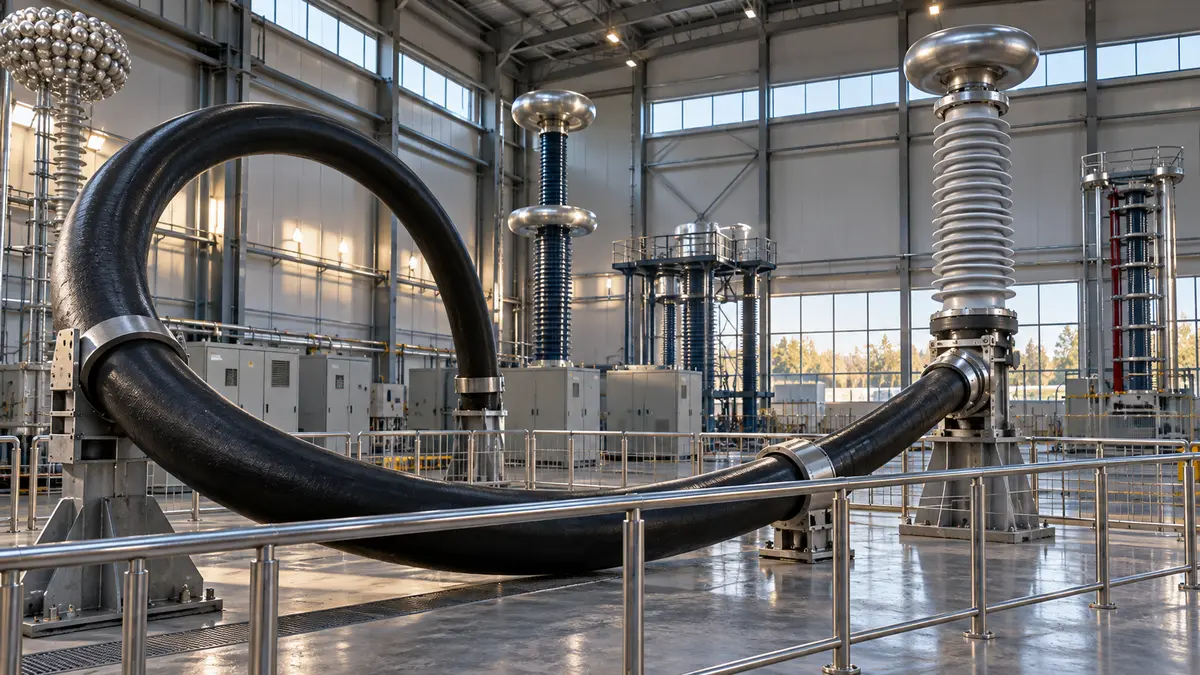
An export option for the U.S. plant
Nexans was considering a European export role for its Charleston, South Carolina, plant in November 2024 if policy changes disrupted offshore wind in the United States. The factory makes undersea cables for that market. At the company’s Capital Markets Day, deputy chief executive and chief financial officer Jean-Christophe Juillard said U.S.-made cables could be redirected with little effect on margins. His assessment concerned a possible response to challenges under president-elect Donald Trump’s second administration; the export option was conditional.
European orders also dominated competitor Prysmian’s transmission business. Its spokesperson put the backlog at €18 billion, entirely in Europe, and its global transmission-market share at about 40%. Prysmian expected that market to remain worth €15 billion annually through at least 2030. Jefferies analysts suggested European capacity could also serve future U.S. projects. These figures and expectations concerned Prysmian, alongside Nexans’ separate plant contingency.

Factories, automation and industrial acquisitions
Nexans announced a €40 million programme for Autun in France on Jan 11, 2023, covering the following three years. The site employed 200 people and belonged to a French network of 14 plants with 2,300 employees at that time. Planned work included automation, digital production controls and expertise in PVC and halogen-free compounds, alongside closer links with recycled copper supplied through Lens. Nexans intended Autun to serve as a test site for industrial digitalisation and employee training in automation. Monitoring would cover production performance, energy consumption and real-time operating indicators. The company had operated there since 1979 and described earlier annual investment of €2 million to €3 million. Its new programme addressed manufacturing equipment, material use and production organisation together, with fire-safety cable development among the intended applications.
A wider digital programme connected Autun with Grimsås in Sweden. Nexans began working with Schneider Electric in late 2020, using those two sites as pilots. In November 2023, the company planned deployment at eight additional plants by year-end and upgrades across 45 plants on four continents by late 2025, at a pace of 12 to 15 sites annually. Those were rollout targets. Nexans put the proportion of group data used at 5% in 2019 and 10% in 2023, with a 70% target for 2026. Its industrial tools included real-time dashboards, monitoring for predictive maintenance, operator tutorials and online exchanges between production teams. At Grimsås, monitoring covered trends in temperature, pressure and traction. Operators at Autun used digital resources to follow developments on their production lines.

The Nordic manufacturing network expanded through the purchase of Reka Cables from Reka Industrial, completed on Apr 26, 2023 after regulatory clearance. Reka was headquartered in Hyvinkää and operated three factories in Finland, complementing Nexans’ existing activities in Sweden and Norway. It manufactured high-, medium- and low-voltage cables for buildings, distribution networks and onshore wind projects. The business had supplied the energy, infrastructure and construction sectors for more than 60 years. For 2022, it reported €172 million in sales at current metal prices and €11 million in EBITDA. Nexans placed Reka within its Distribution & Usage business group. The transaction added manufacturing operations and regional customer relationships to that division; the sales and earnings figures described the acquired company’s preceding financial year. Reka Industrial chairman Markku E. Rentto expected the transaction to create opportunities for the acquired company’s teams to grow and develop within Nexans.
Nexans signed an agreement to buy La Triveneta Cavi on Feb 9, 2024. Ermenegildo Scalabrin, Gastone Massignan and Bruno Gobetti founded the Italian business in 1965. Its industrial locations included Brendola and Tolentino for cable production and Montecchio Maggiore for copper drawing. Nexans identified building wire, fire-retardant systems and renewable-energy applications as areas for developing the portfolio. It cited expected global fire-safety cable demand growth of about 13% annually over 2021–2030. The acquisition valuation represented 5.6 times the target’s 2023 EBITDA before synergies and 4.6 times after anticipated synergies. Nexans also forecast a high-single-digit contribution to earnings per share from the first year. Expected synergies involved integrating operations and applying Nexans’ SHIFT Performance and SHIFT Prime programmes, with an emphasis on customer focus and higher-value solutions. Completion still required regulatory approvals and other closing conditions. Mariano Peripolli, La Triveneta Cavi’s chief executive, expected the partnership to support expansion and fire-safety technology.
Financing and the completed Italian transaction
On May 29, 2024, Nexans announced a successful €575 million bond issue with a five-year maturity and an annual coupon of 4.125%. The stated uses were financing the La Triveneta Cavi acquisition, then subject to regulatory approvals, and/or general corporate purposes. The company identified institutional fixed-income investors in France and abroad as participants. Standard & Poor’s rated the bonds BB+ at the time of the announcement, and they were admitted to Euronext Paris’ regulated market from their issue date. Juillard described the issue as the group’s largest. The principal amount was a financing transaction, separate from individual factory investment budgets and the enterprise value assigned to the acquisition.
The acquisition closed on Jun 6, 2024. La Triveneta Cavi brought approximately 700 employees and four production units into Nexans’ European network. Its manufacturing footprint comprised:
- Three cable production units.
- One in-house copper drawing facility.
The acquired company served applications across 30 countries and had generated more than €800 million in sales over the preceding twelve months. Nexans put the enterprise value at around €520 million. That figure described the transaction’s enterprise valuation, while the sales figure covered the target’s trailing twelve-month business activity.

Halden’s expanded subsea cable capacity
Nexans officially opened the expanded section of its Halden factory in Norway on Jun 6, 2024. Construction had begun in November 2021. The 34,000-square-metre extension was designed to more than double the site’s capacity for extruded high-voltage direct-current cables. It included a second extrusion tower, 152.89 metres tall, and additional insulation lines. The plant, originally built in 1974 for the Skagerrak 1 and 2 interconnectors with Statnett, marked its fiftieth anniversary that year.
The expanded facility was equipped for subsea cables rated up to 525 kV direct current and 420 kV alternating current. Nexans hired and trained 100 additional people, bringing employment on site to around 1,000. Halden also had high-voltage testing facilities and a loading slip for transferring cables directly to laying vessels. The company named Nexans Aurora and C/S Skagerrak among those vessels, alongside Nexans Electra, which was still under construction at the time of the opening.

Equipment programmes across France and Belgium
At Bourg-en-Bresse, Nexans announced a €15 million investment on Aug 29, 2024. The programme covered 2024–2026, with new equipment scheduled to roll out from the first half of 2025 to the first half of 2026. A new stranding machine would produce larger aluminium conductor sections, including 400 square millimetres; an XLPE triple extruder would add insulation capability. Sheathing and assembly lines were also due for modernisation, together with digital controls in the workshops. The medium-voltage programme was intended to serve grid operators, installers and renewable-energy projects in France and Western Europe. Nexans also planned to expand production of reinforced direct-buried EDRMAX cables. Elyette Roux, vice-president for Power Distribution Cables & Accessories, linked the investment to responding to changing customer requirements. The announced timetable described planned equipment deployment, with the machines expected to be operating in the first half of 2026.
A separate €90 million programme announced on Sep 12, 2024 covered Charleroi and Erembodegem in Belgium and Calais in France. Work was planned for 2025–2026. Charleroi would receive a 53-metre insulation tower for onshore 525 kV direct-current cables with conductor sections of 3,000 square millimetres. These cables were intended for TenneT’s BalWin 3, LanWin 4 and LanWin 2 grid projects. Other equipment included a stranding line, a degassing system for direct-current cables and an aluminium drawing line. Calais was to gain a laboratory hall for 525 kV testing, while the accessories operation associated with Erembodegem would receive a new injection press. Most of the budget was directed to Charleroi. The cable cross-sections were conductor areas, distinct from cable voltage ratings.

Copper preparation forms another part of the production chain. On Oct 22, 2024, Nexans announced a partnership with Continuus Properzi for a new copper production and recycling installation at Lens, planned for 2026. Investment was put at more than €90 million. The project aimed to increase wire-rod capacity by over 50% and process up to 80,000 tonnes of copper scrap annually. The refining process was intended to accept up to 100% recycled metal as input for rod production. Separately, Nexans targeted a 30% recycled-copper share in its cables by 2030. The Lens site dates from 1971, and the company already participated in recycling through Recycâbles, its joint venture with Suez established in 2008. The Lens investment was supported by France 2030 financing.
The European Investment Bank announced €250 million in financing for Nexans on Sep 22, 2025. The package supported research, development and innovation programmes for 2024–2029, together with industrial investments. It comprised two contracts: €190 million backed by an InvestEU guarantee and a further €60 million loan. The projects covered included Lens, the Charleroi–Erembodegem–Calais programme and Bourg-en-Bresse. EIB vice-president Ambroise Fayolle linked the financing to innovation, production capacity and access to copper. Christopher Guérin, Nexans’ chief executive at the time, described it as support for industrial development and recycling. The operation also aligned with REPowerEU, the European programme supporting energy autonomy. The EIB linked cable systems to electrification from production to end use. The financing package brought those existing projects into a common lending framework; the announcement did not give a drawdown schedule for the two contracts.

Financial periods and the changing group perimeter
Nexans’ financial releases distinguish sales at standard metal prices from sales at current metal prices. For 2023, the group reported €6.5 billion on the standard-price measure and €7.8 billion at current prices. Results released on Feb 15, 2024 included adjusted EBITDA of €665 million, up 8%, and a 10.2% adjusted margin. EBITDA including share-based payments was €652 million. Normalised free cash flow reached €454 million, with net debt of €214 million and leverage of 0.4 times. The adjusted Generation & Transmission backlog stood at €6.1 billion. At that stage, the company forecast 2024 adjusted EBITDA of €670 million to €730 million and normalised free cash flow of €200 million to €300 million. Those forward estimates preceded the upgrades issued later in 2024.
The first-half 2024 release, published on Jul 24, put standard-price sales at €3.5 billion and current-price sales at €4.2 billion. Organic growth was 6.1%; second-quarter standard-price sales were €1.9 billion, with 9.4% organic growth. Adjusted EBITDA reached €412 million, up 16.4% year on year, and the adjusted margin was 11.6%. Nexans raised its full-year adjusted EBITDA forecast to €750 million–€800 million and its normalised free-cash-flow forecast to €275 million–€375 million. Guérin said the Halden expansion had begun to benefit Generation & Transmission and identified the completed Italian acquisition as an expansion of Usage capabilities. These were the company’s mid-year figures and expectations, covering a half-year reporting period.

For the full 2024 year, Nexans reported standard-price sales of €7.1 billion and current-price sales of €8.5 billion. The release on Feb 19, 2025 put reported sales growth at 8.7% and organic growth at 5.1%, while Electrification businesses grew 13% organically. Adjusted EBITDA was €804 million, up 21%, with an adjusted margin of 11.4%. Normalised free cash flow was €454 million, and the adjusted PWR-Transmission backlog reached €7.4 billion. Net debt stood at €681 million. The company also began its 2025–2028 strategic roadmap, following the 2021–2024 programme. Its initial 2025 forecast was adjusted EBITDA of €770 million–€850 million and free cash flow of €225 million–€325 million. Subsequent disposals and accounting presentation changes affected later comparisons.
The Jul 30, 2025 half-year release showed standard-price sales of €3.8 billion and current-price sales of €4.7 billion, with organic growth of 4.9%. Electrification businesses grew 7.8% organically. Adjusted EBITDA was €441 million, up 7%, with an 11.7% adjusted margin. Free cash flow of €282 million included an exceptional level of customer downpayments, and cash conversion reached 64%. Net income of €374 million also reflected gains from the AmerCable and Lynxeo disposals. The upgraded full-year outlook excluded six months of Lynxeo, included seven months of Cables RCT and excluded future scope changes. These qualifications defined the forecast’s business perimeter, alongside the reported half-year operating results.

The 2025 results released on Feb 19, 2026 classified AmerCable, Lynxeo and Autoelectric as discontinued operations under IFRS 5 and restated the 2024 comparison. On that continuing-operations basis, adjusted EBITDA was €728 million against €571 million, with margins of 11.9% and 10.3%, respectively. Standard-price sales reached €6,098 million and current-price sales €7,810 million in 2025. The comparison therefore used the restated scope rather than the previously published broader group figures.
Capital expenditure in 2025 totalled €383 million, equivalent to 6.3% of standard-price sales. Major spending concerned the Electra cable-laying vessel and the Charleroi factory extension. Free cash flow reached €344 million, benefiting from above-average PWR-Transmission downpayments. Net debt at year-end was €266 million. Recycled copper content reached 19.3% in 2025, with a 25% target for 2028.



















Leave a comment