
Robots and scheduling across Nucor’s factories
Nucor is automating steel-product manufacturing to lower costs and improve safety. On 22 July 2024, CEO Leon Topalian highlighted applications across its businesses. The company reported its safest first half, with zero recordable injuries at 52 of 109 divisions. Second-quarter sales nevertheless fell 15% year on year to $8.1 billion. Steel-product volumes increased, but average selling prices fell amid higher material costs.
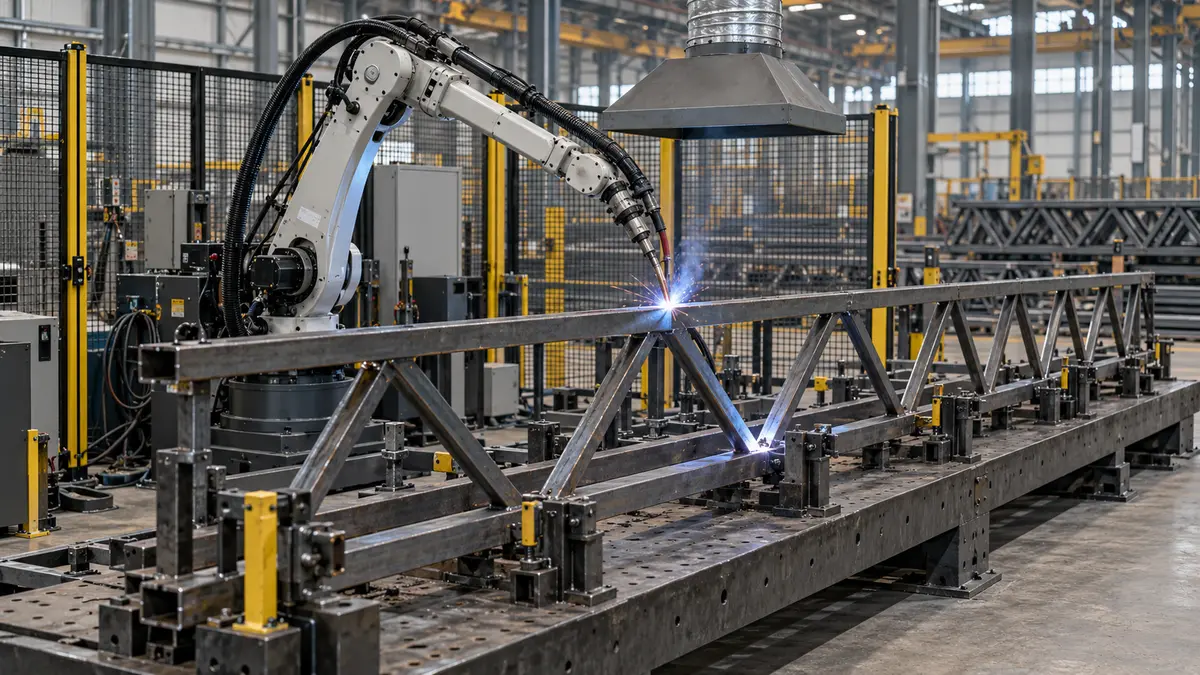
New Markets and Innovation executive vice president Chad Utermark outlined automated handling, robotic plasma cutting and welding cells for planned utility-structure plants in Crawfordsville, Indiana, and Decatur, Alabama. He expected automation to help serve customers through demand fluctuations. Fabricated Construction Products executive vice president John Hollatz said AI scheduling at Memphis, Tennessee, reduced hours devoted to that process by about 80%. At Vulcraft South Carolina, a joist line developed over six years had operated for about a year. Its patented robotics and vision technology assembled and welded joists; Hollatz envisaged expansion to other joist operations.

A transmission-tower plant beside the Decatur mill
Nucor selected Decatur for its first new transmission-tower production plant on 22 February 2023. The proposed site lay beside the existing Nucor Steel Decatur sheet mill in the United States. Nucor expected the development to create 200 full-time jobs. The manufacturing design combined highly automated, straight-line production with advanced hot-dip galvanizing operations for utility infrastructure and construction customers.
The Towers & Structures business had formed in 2022 after Nucor acquired Summit Utility Structures, a manufacturer of metal poles and other utility structures. In December 2022, Nucor proposed two new tower plants with a combined investment of $270 million. That amount covered both developments. Topalian expected Nucor’s steelmaking operations to supply the Alabama factory efficiently. The company identified grid hardening, renewable-energy projects, electric-vehicle charging networks, storm damage, equipment replacement and population growth as sources of demand. It also anticipated additional demand from federal infrastructure and clean-energy funding.

Crawfordsville becomes the second utility-structures location
Nucor chose Crawfordsville for the second production facility on 14 June 2023. Its proposed location was adjacent to the Nucor Steel Crawfordsville mill. The company forecast 200 additional full-time jobs for this development. Straight-line automated production and hot-dip galvanizing were specified for the Indiana operation as well as its Alabama counterpart. The announcement established the second location while the new manufacturing facilities remained planned investments.
Topalian linked the expansion to utility-infrastructure demand from renewable energy, growing charging networks and grid hardening. Governor Eric Holcomb welcomed the project’s role in Indiana’s energy supply chain and Montgomery County’s manufacturing economy. Towers & Structures general manager Laurent De Mey noted that Nucor had operated in Indiana since 1972 and employed more than 2,500 people at multiple state locations in June 2023. He acknowledged support from Holcomb, commerce secretary Brad Chambers, the Indiana Economic Development Corporation, Montgomery County and the City of Crawfordsville.
Remote guide setting at Sedalia
Nucor Steel Sedalia installed four Danieli Morgårdshammar RX intelligent guides at the entrances to rolling stands 14 and 16. By 15 February 2023, the equipment was in operation at the Missouri micromill. The supply included consumables for rebar sizes 4, 5 and 6, corresponding to 13, 16 and 19 millimetres, and a local guide-setting control station in the guide shop.
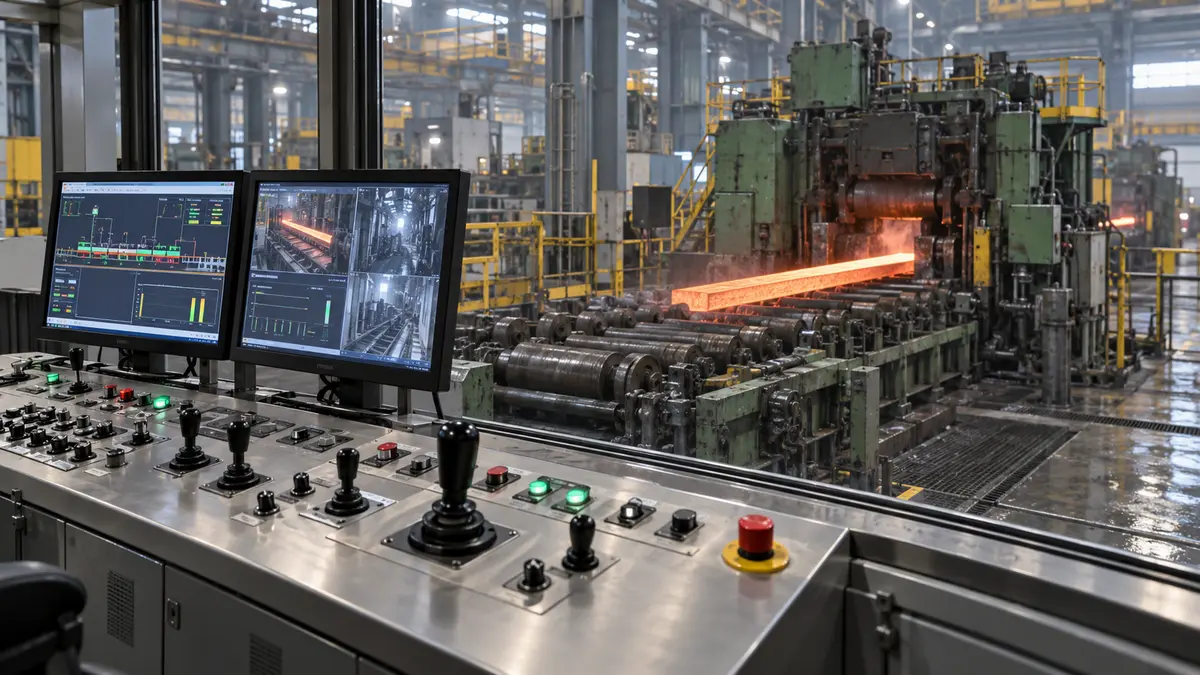
The guides’ human-machine interface was incorporated into the mill’s existing Danieli Automation control system. Operators could monitor and adjust the guides from the pulpit while receiving real-time information about bar dimensions, bar behaviour and wear in upstream passes. The feedback covered multiple stands, allowing mill staff to observe conditions and change settings remotely.

Danieli described the installation as the first use of its intelligent guides on a continuous casting-and-rolling MIDA micromill. The supplier said remote control removed the need for manual intervention at the mill during rolling. Nucor and Danieli envisaged further installations to support safety, quality and productivity.
Billet welding and spooled rebar in Utah
Nucor Steel Utah added a Danieli K-Welder to its long-product rolling mill in Plymouth. By 13 June 2023, the operation was producing spooled rebar in endless rolling mode, with coils weighing up to five tons and bar sizes from 3 to 8. The installation combined billet welding with a spooler line rather than treating the two items as separate production routes.

The project proceeded in stages. The spooler entered service in 2022; the billet welder followed during the plant’s March 2023 outage. A removable temporary support structure allowed rolling to continue while permanent concrete foundations were built. The welder equipment was installed off-line to limit disruption to production.
Danieli identified higher material yield, improved efficiency and reduced coil handling among the expected benefits of the combined K-Weld and K-Spool processes. It also associated endless rolling with a lower risk of cobbling. The equipment represented Nucor’s first Danieli billet welder and its third operating Danieli spooler in the country.
Heating controls for the Blytheville beam mill
Nucor-Yamato Steel ordered a walking-beam reheating furnace for its beam mill in Blytheville, Arkansas. Danieli announced the order on 25 July 2023, specifying a throughput of 180 short tons an hour and material-handling equipment on both sides of the furnace. A phased layout was intended to retain much of the existing equipment and keep the older furnace available during installation.
The new furnace was designed to use Danieli’s Hydro-Mab burners, capable of firing with up to 100% hydrogen. The supplier’s proposed level 1 and level 2 controls would link heating set points to stock temperature, material tracking and the mill’s actual production pace. Automatic adjustments were intended to maintain consistent reheating profiles while accommodating different production requirements.

Danieli also undertook to provide installation advice and training. Its July 2023 timetable anticipated operation in spring 2025.
Robotics and process models on the Brandenburg caster
Nucor Steel Brandenburg was ramping up its SMS single-strand slab caster in March 2023. The Kentucky installation was designed for 1.45 million metric tonnes of slabs annually, equivalent to 1.6 million short tons. SMS’s 29 March update identified produced slab thicknesses of 203–305 millimetres and widths of 1,524–3,150 millimetres. Slab lengths ranged from 2,642 to 15,240 millimetres.

The vertical-bending caster incorporated robot applications on its casting platform, optical fibres in the mould and electromagnetic stirring. Liquid Core Reduction operated in segments 0–6, alongside quench cooling, tiltable foot rollers, a dedicated strand-guidance system and secondary cutting equipment. SMS’s X-Pact packages supplied process guidance, solidification control and technological assistance, including Dynamic Soft Reduction.
Maintenance staff could measure moulds and containment segments using HD LASr alignment equipment in the workshop. The caster formed part of the supply chain for heavy plate, including material used in offshore-wind monopile foundations. Its stated annual capacity concerned cast slabs.

Burner control, heat treatment and maintenance support
Nucor’s Brandenburg facility had celebrated its inauguration by the time SMS issued its 15 January 2024 announcement. SMS’s equipment supply extended from casting to walking-beam and bogie-hearth furnaces, continuous heat treatment, heavy-plate treatment and water treatment. The reheating furnace incorporated ZEROFlame burners with low-NOx, flameless operation.
The X-Pact DigiMod control system combined modulation of burner zones with digital control of individual burners. Its role was to maintain the required flame pattern and furnace thermal profile under changing operating conditions. A separate X-Pact Prometheus heating-optimization system targeted temperature uniformity for different materials and steel grades while limiting fuel consumption, decarburization and scale loss.
SMS established an on-site repair centre under a long-term service agreement for caster moulds and containment segments. The centre also contained an HD scan unit for examining slab microstructure and quality, alongside alignment equipment. A team of 22 SMS employees provided mechanical and electrical maintenance support across the plant. These service capabilities accompanied the production equipment.
Automated plate rolling and finishing
Nucor Steel Brandenburg hosted visitors during Danieli’s Innovaction Meeting in 2024. The supplier’s 3 June account identified the mill as an installation of its MultiPlate concept, with two heavy-duty rolling stands, in-line quenching and a multipurpose leveler. Its plate-production design capacity was 1.2 million short tons annually. This was a finished-plate figure, separate from the caster’s slab throughput.
The equipment handled both ingots and slabs. Its operating modes included straight rolling, cross-rolling, flat rolling and Steckel rolling. Danieli specified production of wide heavy plate as well as lighter discrete and coiled plate, with yield strengths reaching 1,800 megapascals. The product range addressed construction, energy, oil and gas, mining, earth-moving machinery and defence applications.
Thermo-mechanical control and Exstream II cooling supported the production of advanced grades. Danieli associated the cooling system with reduced alloying requirements. An Evo 6 hot leveler accommodated two cassette types, while the finishing and shearing line handled and cut mother plates up to 250 feet long.
Gallatin’s staged switch to a new execution system
Nucor Steel Gallatin replaced its internally developed production-planning system with SMS digital’s MES 4.0 at Ghent, Kentucky. By 16 March 2023, the plant had produced its first hot coil after the software upgrade. Integration covered both production equipment and the connection to Nucor’s enterprise resource planning system.
The modular suite brought together several planning and control functions:
- A technical order generator and capacity planner for manufacturing requirements.
- A production sequencer and short-term scheduling for order allocation and rescheduling.
- A quality manager and production controller, with quality execution software supporting evaluation and dispatch certification.
Existing lines received the first-stage upgrade. Following integration tests and a shadow period using production data in parallel, the new system took over within 16 hours. The additional melt shop, caster, hot-strip-mill extension and pickling-and-galvanizing line were incorporated subsequently. Remote commissioning helped the teams work around pandemic constraints and Nucor’s expansion timetable. Final commissioning was arranged around the annual shutdown.
Tuscaloosa’s planned tandem mill and camera controls
Nucor commissioned SMS to upgrade its Tuscaloosa Steckel mill on 16 October 2024. The ordered modernization would add a downstream stand, creating a tandem arrangement for roughing and finishing passes. Replacement closed-design Steckel furnaces would retain product temperature and shield roller tables from heat radiation.
Both stands were to receive CVC plus profile and flatness control, combining specially contoured rolls with bending and axial shifting. An inter-stand looper would manage tension and assist speed control. Electrical modernization covered drives, sensors, measuring equipment and basic and process automation. X-Pact Centerline Control would use intelligent cameras with level 1 functions for automated strip guidance.
Independent drives would operate top and bottom work rolls. Genius CM would supply condition-monitoring data for maintenance. Level 2 models would calculate pass schedules and manage profile and flatness, alongside material tracking. SMS planned a Plug & Work integration test before shipment and continuing support through its service portal after commissioning.
Three linked supply-chain applications
Nucor was using three C3 AI applications across multiple facilities by 4 September 2024. Demand Forecasting, Inventory Optimization and Production Schedule Optimization worked together in the supplier’s Supply Chain Suite. C3 AI associated the deployment with improved manufacturing outcomes and support for daily decisions.
The named applications addressed forecasts, inventory and schedules within the same deployment. C3 AI characterized their combined operation as successful, but its announcement supplied no numerical Nucor savings or production improvement. The update concerned an existing multi-facility implementation, rather than a stated start date for each individual application or factory.
Process optimization through Azure Marketplace
Fero Labs made its AI process-optimization software available through Microsoft Azure Marketplace on 17 June 2025. The company announced the change at the Global Steel Dynamics Forum. Its product offering included explainable process optimization and digital-twin capabilities for industrial engineering teams.
Chief executive Berk Birand linked the Azure partnership to demand from enterprise customers for faster deployment. He expected direct integration to help process engineers use AI-based decision support. Fero specifically identified Nucor as a steel producer benefiting from simpler implementation and adoption across multiple mills, including easier access to a trusted data source for its engineers.
Azure Marketplace provided a channel for finding and purchasing cloud solutions certified to run on Azure. Fero’s software became available through that channel, with easier deployment and wider adoption presented as benefits for Nucor’s engineering teams.
A broader enterprise AI programme
Nucor expanded its relationship with C3 AI into a multi-year programme by 3 September 2025. The proposed enterprise-wide scope extended across steel mills, steel-product manufacturing and raw-material operations. Initial Supply Chain Suite deployments were already live at multiple facilities on the C3 Agentic AI Platform, supporting planning, inventory and scheduling decisions.
C3 AI described further expansion to additional plants and use cases, including agentic AI. The stated priorities were throughput and working-capital efficiency across Nucor’s value chain. The supplier also named Nucor among customers with C3 Generative AI agreements during the quarter.
Vulcraft’s subsequent Indiana manufacturing investment
Nucor announced a further $59 million investment in its Vulcraft Indiana facility on 13 August 2026. The planned expansion in St. Joe would add steel-grating production capabilities. Nucor expected 20 new full-time positions, supplementing more than 300 employees already at the site. John Hollatz linked the project to stronger downstream production and customer service.
Vulcraft’s manufacturing history preceded the group’s own steelmaking. Nucor acquired the company in 1962, entering the steel industry through a South Carolina production facility. Vulcraft Indiana opened in 1972 as the fifth Vulcraft plant. By the August 2026 announcement, the business operated nine facilities across North America and had approximately 1.2 million tons of annual joist-and-deck production capacity.
Its open-web joists, joist girders and steel decking provided structural support for roofs and floors in nonresidential buildings, including factories and data centres.



















Leave a comment