
An expanded role for the Pennsylvania factory
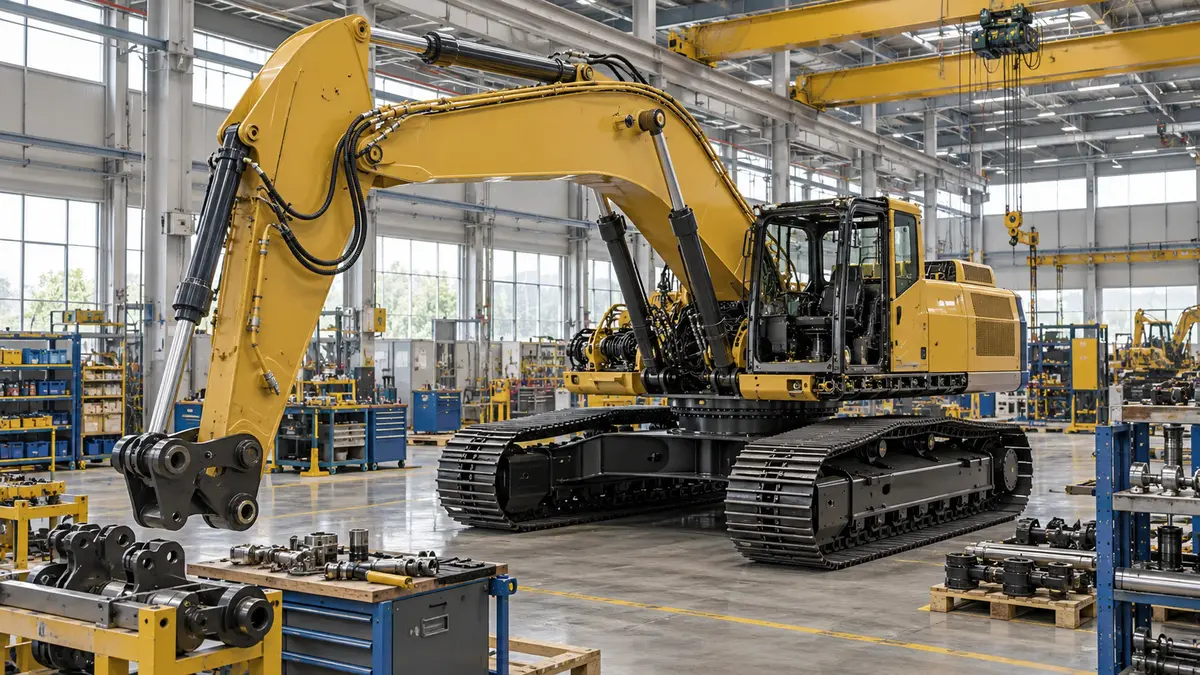
Volvo Construction Equipment planned to add medium and large crawler excavators and four large wheel-loader models at Shippensburg, Pennsylvania. The expansion formed part of a $261 million global excavator-production programme covering the United States, Changwon in South Korea and a location in Sweden. Existing Shippensburg production included soil and asphalt compactors and midsize loaders. New assembly lines, automation and employee training were intended to use existing factory space, with production readiness expected in the first half of 2026. North American head Scott Young anticipated that local manufacturing could supply more than half the region's machines. Volvo CE also announced a separate $40 million community investment over five years. The June 2025 plans followed its acquisition of the site from Ingersoll Rand in 2007 and establishment of its regional headquarters there in 2012. Manufacturing Dive coverage.
Training capacity before the assembly expansion
Shippensburg already had a larger technical-training operation before the excavator investment. On Aug 18, 2023, Volvo CE opened a $7.3 million training centre with a 20,000-square-foot addition that doubled the building's size. Three service bays could accommodate machines as large as the L350H loader, A60H articulated hauler and R100 rigid hauler throughout the year. Courses covered diesel and electric machinery alongside machine-control systems, connectivity and productivity services. Maintenance, diagnostic and repair qualifications formed three certification levels, supplemented by certification for commissioning and decommissioning electric equipment. Volvo CE expected the enlarged centre to double annual student numbers. Senator Bob Casey put its capacity at more than 500 people annually. Hands-on teaching accompanied virtual instruction for participants elsewhere. Local firms HRG, NUTEC and Waynesboro Construction worked on the development. Tim Watters of dealer Hoffman Equipment joined the opening, alongside Scott Young, then acting regional head, and U.S. Representative John Joyce. Volvo CE described the centre as certified landfill-free.

Changwon's separate electrification investment
Changwon's manufacturing role extended beyond conventional excavator assembly. On Feb 17, 2023, Volvo CE announced an SEK 80 million investment from Volvo Group for battery-pack production at the South Korean factory. The site occupied approximately 1.1 million square metres and produced around 55% of Volvo CE's excavator volumes at that time. A new facility of about 2,500 square metres, including assembly and logistics areas, was planned inside the existing component workshop without interrupting current operations. Building work was scheduled to start in April 2023, with battery-pack manufacturing expected in June 2024. The packs were intended for Volvo Group applications, while Changwon would develop expertise in electric excavators. Andy Knight, head of excavator operations and managing director of Volvo Group Korea, pointed to nearby battery-module suppliers and the workforce's existing skills. The planned operation included supply-chain, manufacturing and logistics activities serving Asia-Pacific markets. Those dates were project forecasts accompanying the investment announcement.
The crawler products entering the wider network
Volvo CE's excavator renewal also changed the products offered to North American customers. Its EC260 replaced the EC250, while an updated EC300 continued the larger model's place in the range. The announcement was originally dated Nov 26, 2024; the current product description carries a September 2026 edit. Product manager S.S. Kim identified site preparation, road construction and utilities as applications for these 26- and 30-ton machines. The generation incorporated an electro-hydraulic system, engine-speed regulation and revised cooling. Volvo CE claimed fuel-efficiency improvements of up to 15%. Ten work modes included power settings and automatic ECO modes, with creep travel and boom-and-arm shock reduction among the operating features. Volvo Smart View with Obstacle Detection combined surrounding visibility with differentiation between people and objects. Active Control automated boom and bucket movements. Cab changes included revised seating, additional storage, keyless starting and a larger Co-Pilot display. The company listed eight models in the generation, with further additions planned.

A broader product-renewal programme
The January 2025 articulated-hauler launch broadened the manufacturing context beyond crawler excavators. On Jan 28, Volvo CE introduced an updated A25–A60 range and the new A50, with market introductions scheduled in stages during the year. The overhaul included revised electronics, an upgraded operator cab and an internally developed transmission intended to accommodate future drivetrains. Volvo CE claimed fuel-efficiency improvements of up to 15%, depending on the model and industrial application. The A50 added another size option for customers, with availability limited to selected markets. Haul Assist provided onboard weighing as part of the supporting digital offering. The company also began introducing low-carbon steel into serial production of haulers at Braås in Sweden. That material used recycled inputs, fossil-free electricity and biogas. President Melker Jernberg presented the launch as a continuation of the company's articulated-hauler development. Volvo CE calculated that more than 35% of its overall product range had been renewed during the preceding twelve months.
Loaders receive new controls and assistance systems
Five wheel loaders formed the first North American wave of another product renewal announced on Apr 29, 2025: the L150, L180, L200 High Lift, L220 and L260. The current announcement, edited in July 2026, details load-sensing hydraulics, automatic bucket levelling and an optional Auto Bucket Fill function controlling throttle, lift and tilt. Volvo CE claimed that its default Smart Control engine mode could reduce fuel use by up to 4% without reducing productivity. Product manager Eric Yeomans described the changes as part of a wider effort to adapt equipment to customer requirements. A 12.8-inch Co-Pilot touchscreen was 20% larger than its predecessor and could display four widgets. Optional Comfort Drive Control allowed steering with a lever. Digital options included onboard weighing, operator coaching and tyre-pressure monitoring through Load Assist. A load-ticket function supported invoicing, while Connected Map and Performance Indicator addressed mixed-fleet jobsites. ActiveCare Direct provided equipment monitoring and operational alerts.

Changes to the industrial portfolio
The expansion of some machine families accompanied plans to transfer another business. On Dec 14, 2023, Volvo CE agreed to sell its global ABG paver operation to Switzerland's Ammann Group. The transaction included the production and technology centre at Hameln in Germany. Ammann intended to invest in the paver business and develop its product portfolio and distribution. Approximately 400 employees were affected by the announcement. Volvo CE planned to phase out its own compaction-equipment production in Hameln over time as a consequence of the divestment. Customers were to retain access to ABG machines, aftermarket provision and other support through Ammann's network and selected Volvo CE dealers. Completion remained conditional on regulatory approval and works-council consultations, with closing then anticipated during the first half of 2024. The agreement separated the intended ownership transfer from the continuing routes through which customers could obtain machines and support. Its announced scope covered three connected elements:
- The global ABG paver business.
- Hameln's production and technology centre.
- Continuing equipment availability and aftermarket support through designated distribution channels.
A different ownership model in China
On Jun 24, 2025, Volvo CE agreed to sell its entire 70% stake in Shandong Lingong Construction Machinery, or SDLG, to a fund predominantly owned by Lingong Group. The agreed consideration was SEK 8 billion, with closing initially expected in the second half of 2025 subject to approvals and other conditions. Volvo CE had acquired its majority holding in 2006. Jernberg attributed the decision to competitive pressure, technological change and the need for closer customer interaction. Volvo CE intended to concentrate its own brand on selected Chinese segments, including mining, quarrying, aggregates and heavy infrastructure. Its excavator factory in Shanghai, operating since 2002, would continue to serve domestic and export markets. The company also planned to strengthen the Jinan Technology Center within its global development organisation. Chinese suppliers remained part of its industrial system. The subsequent third-quarter results confirmed completion of the SDLG disposal on Sep 1, 2025, while retaining Volvo-branded production and technology activities in China.

Retail operations become another investment focus
Volvo CE also agreed on Jun 24, 2025 to acquire Swecon's operations from Lantmännen, including Entrack. The business covered Sweden, Germany and the Baltic countries, with 1,400 employees, offices and workshops included in the proposed transfer. Sales of products and services, rentals, aftermarket work and customer support all fell within the transaction's scope. Swecon's 2024 revenue had reached SEK 10 billion. Volvo CE expected the acquisition to bring the majority of its European business under directly owned and managed retail operations. Jernberg emphasised customer contact, while European sales head Carl Slotte pointed to changing customer requirements and new business models. Lantmännen president Magnus Kagevik described Volvo CE as a prospective owner able to continue the business's development. Entrack supplied aftermarket products and operated independently within Swecon, with a presence in Sweden, Italy, Finland and Poland. The June agreement still required regulatory approval and anticipated completion in the second half of 2025; that announcement did not establish a completed transfer.
Orders and sales moved differently in early 2025
Volvo CE entered the production-expansion period with different movements in revenue, orders and physical deliveries. First-quarter 2025 net sales were SEK 21,117 million, against SEK 22,877 million a year earlier, a reported decline of 8%. Adjusted for currency movements, machine sales fell 10%, while service sales increased 2%. Deliveries rose 12% and order intake increased 24%. Orders grew across the regions except South America, with SDLG orders increasing 30%. The surrounding machine markets were uneven: Europe declined 18% and North America 14%, while South America grew 12%, China 42% and Asia excluding China 1%. These were regional market movements alongside company performance, with their own geographic bases. The quarter also included a partnership with Unicontrol for three-dimensional machine control. Volvo CE presented the A30 Electric and A40 Electric at Bauma, with selected European customer availability expected in 2026. Those electric-hauler plans remained future introductions rather than completed customer deliveries in the first quarter.

The investment programme during a weaker sales quarter
Second-quarter 2025 net sales reached SEK 22,906 million, down 6% from SEK 24,423 million a year earlier. Currency-adjusted sales increased 2%, with machine sales up 2% and services unchanged. Adjusted operating income fell to SEK 2,993 million from SEK 3,888 million, giving a margin of 13.1% against 15.9%. Order intake increased 24%, including 26% growth for Volvo-branded equipment, and deliveries rose 11%. Dealer replenishment continued in Europe. North American orders increased from a relatively low level. Regional machine markets in Europe and North America each declined 10%, while China grew 26%, South America 8% and Asia excluding China 6%. Volvo CE associated the North American weakness with rental-fleet repositioning and uncertain customer demand. In Europe, increased dealer stock had yet to reach end users amid relatively saturated demand. Jernberg continued to emphasise customer proximity and investment while managing uncertainty. The quarter's stronger orders and deliveries therefore accompanied lower reported sales and a reduced operating margin.
A changed comparison after the SDLG disposal
Third-quarter 2025 sales increased 1% to SEK 18,926 million. Currency-adjusted sales grew 8%; excluding SDLG as well, the increase was 14%, comprising 17% for machines and 6% for services. Adjusted operating income reached SEK 2,722 million and the margin was 14.4%. Volvo CE attributed the performance to product mix and improved services offsetting tariff costs and lower volumes. Reported order intake declined 2%, whereas orders excluding SDLG increased 22%. Similarly, reported deliveries fell 4%, while deliveries excluding SDLG rose 14%. Volvo-brand orders included continued European dealer replenishment and North American fleet and stock adjustments ahead of 2026. Higher deliveries in Europe and the Middle East were partly offset by lower North American deliveries as dealers balanced inventories. Europe's overall machine market grew for the first time in more than a year. North America's market also expanded, partly reflecting purchases ahead of anticipated tariff-related price increases. South America's machine market contracted, with Brazil contributing to the decline.
Year-end finances and the Swedish assembly location
By the fourth quarter of 2025, Eskilstuna had been confirmed as the location for Volvo CE's new European crawler-excavator assembly plant, covering 30,000 square metres. The company also began delivering L120 Electric loaders to selected customers in Europe and Asia. Fourth-quarter reported net sales fell 16% to SEK 18,692 million from SEK 22,197 million. Adjusting for currency movements and the SDLG disposal, sales increased 12%, including 13% growth for machines and 8% for services. Adjusted operating income was SEK 2,599 million against SEK 2,609 million; the margin increased to 13.9% from 11.8%. Currency movements reduced earnings by SEK 653 million. Full-year sales were SEK 81,641 million, compared with SEK 88,305 million in 2024. Full-year adjusted operating income reached SEK 10,856 million against SEK 12,737 million, and the margin was 13.3% versus 14.4%. At the Jan 28, 2026 results announcement, Swecon's transfer was still expected on Jan 31 following European Commission approval.
Delivered machines and reconfigured production lines
On Aug 19, 2026, Volvo CE marked delivery of its first U.S.-built excavators and large loaders at Shippensburg. The company said eleven additional models would bring the factory's portfolio to thirty and more than half its North American machine supply would be produced there. It claimed customer lead times were shorter by more than six weeks. The existing 436,000-square-foot assembly and fabrication footprint had been reconfigured into three flexible lines, with new excavator welding capacity. More than 750 people worked at the location. Employees trained with sister factories in Sweden, Korea and Brazil, completing more than 180 hours of individual training. Large-loader production used cross-trained utility specialists to support stations needing additional labour. Volvo CE also set an ambition to increase business with Pennsylvania suppliers by 30% by 2030. A counterweight supplier was investing more than $1.5 million locally. These were developments presented at the August 2026 factory event.




















Leave a comment