
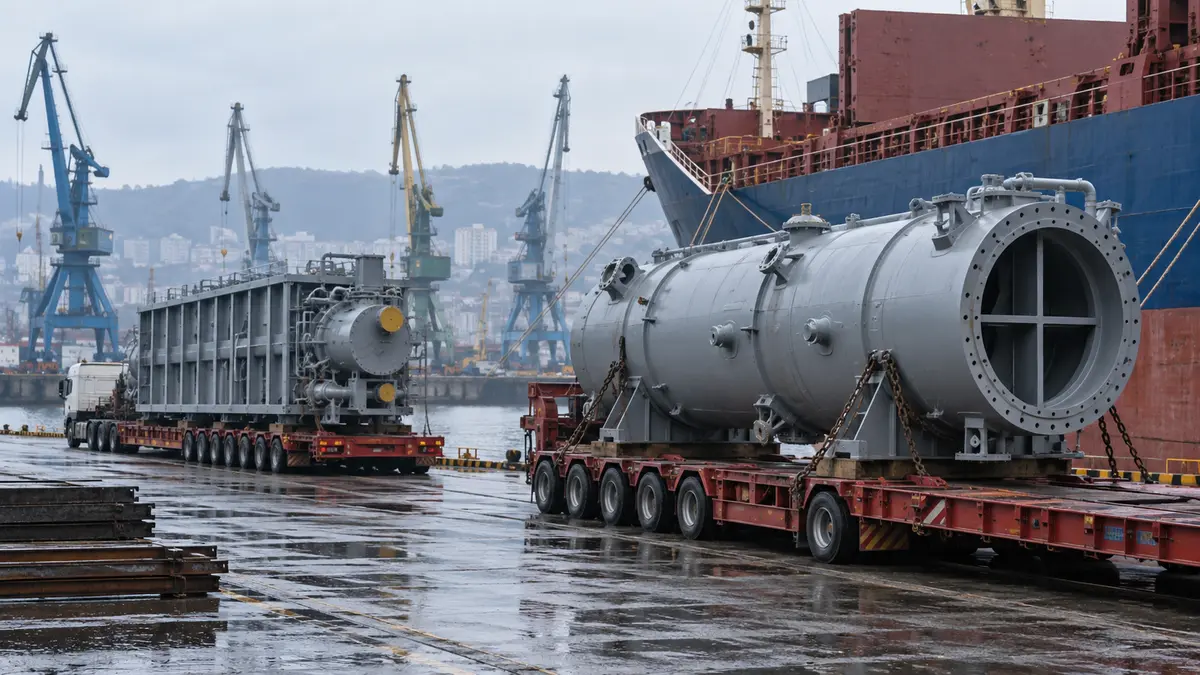
Equipment arrives for expansion
Osterra, the Daltransugol coal terminal in Russia's Khabarovsk territory, has received 2,000 tonnes of equipment from China for its next expansion phase. Development and manufacture took nearly two years; the largest components weigh 32–46 tonnes. The shipment supports construction involving 14 facilities.
A second batch was scheduled for May and installation for July 2026. Equipment commissioning was planned for September 2027, with the facilities due by year-end. The terminal's target is 40 million tonnes annually; the last stage carries an estimated 16 billion rouble cost. Legal procedures to rename Daltransugol as Osterra remain pending.
- A triple rotary car dumper and wagon positioners.
- Briquetting, dust-control and aspiration systems.
- Automated controls for terminal processes.
- Construction includes a bridge, conveyor structures and foundations.

Earlier railway connection
Daltransugol had already expanded its annual handling capacity from 24 million to 32.8 million tonnes by June 2025. Chief executive Vladimir Dolgopolov announced the completed project on Jun 5, after receiving the railway acceptance certificate the previous day. Full industrial commissioning was still expected within one or two months of that announcement.
The new 600-metre public railway spur connects Russian Railways' network with 11 kilometres of private terminal tracks. Dolgopolov identified railway bottlenecks as a constraint on cargo volumes and described the 26.5 billion roubles under the company's development-corporation agreement as borrowed funds. The terminal handled 6.8 million tonnes in January–May 2025, up 43% year on year.

Actual cargo volumes
Osterra handled 19.6 million tonnes of export coal across the full 2025 calendar year, compared with 14.5 million tonnes in 2024. The terminal operator put the increase at 35.4%. December alone accounted for 2 million tonnes exported to Asia-Pacific destinations, a 56.6% increase over the corresponding month of the previous year.
The operator attributed the higher annual volumes to its first investment phase together with Russian Railways' development programme and new Baikal-Amur Mainline tracks and stations.

Vanino infrastructure
The terminal, constructed in 2008, occupies deep-water Muchke Bay near Vanino, with access to the Trans-Siberian and Baikal-Amur railway routes. Daltransugol became a Free Port of Vladivostok resident in September 2020. Port Alliance manages the earlier expansion project and the subsequent investment programme.
The double-sided pier has two rotary shiploaders, a depth of 21.7 metres and a draft of 18.5 metres. Coal storage capacity is 1.2 million tonnes. These terminal facilities serve a business exporting primarily to Southeast Asian markets.



















Leave a comment